The question this article answersDoes typing help you learn Chinese faster?
Short answerTyping helps you learn Chinese when it forces you to retrieve words from memory. Unlike passive recognition, this repeated active recall strengthens access to vocabulary and reveals which words you do not yet know securely.
Most arguments about Chinese learning methods — handwriting vs. typing, watching dramas vs. drilling exam papers, apps vs. notebooks — skip the root question: what does it mean to "know" a word? Until you answer that, every debate is just arguing about the decor while the foundation sits empty.
1. What does it mean to "know" a word? Three tiers, not one
In a learner's head, a Chinese word exists on three very different tiers:
You see 努力 and nod — "ah, effort." The easiest tier, and the easiest to hallucinate: the brain only has to match a pattern, not reconstruct anything.
You hear "nǔ lì" or see the meaning "to try hard," and you pull up the characters 努力 on your own, without looking at the answer. Much harder — and this is the tier you can actually use when writing.
You use the word correctly in your own sentence, typing it fluently or saying it with the right tones in the right context. The highest tier — and the only one the person on the other side ever sees.
Most traditional study stops at Tier 1: re-reading, underlining, glancing at the answer key. The feeling of fluency at Tier 1 is very real — and very useless the moment you need the word. Matrix Hanzi's philosophy starts from a blunt choice: every mode must push you to Tier 2 or Tier 3, as often as possible.
Recognition gives you the feeling of knowing.
Recall gives you the ability to use.
Production gives you your own voice.
2. Active recall: the engine of all progress
Cognitive science calls the act of pulling information out of memory on your own retrieval practice. Its central finding — the testing effect — says that the act of retrieval itself, not the time spent looking back at material, is what consolidates long-term memory. Karpicke & Roediger place retrieval among the factors of "critical importance"; university teaching centers list retrieval practice as the top active learning strategy.
Why is retrieval so powerful? Every time you try to recall a memory and succeed (or fail and then correct), your brain has to rebuild the neural pathway leading to that memory — like walking a trail until it grows clearer and clearer. Re-reading builds no path: it just shows you the map. And one more property matters: desirable difficulty. The more effort a recall costs — within reason — the more durable the memory. That's why Matrix Hanzi's Deep Memory deliberately has no skip button.
Design consequence: among the six modes, not one lets you "skim the answer" as an escape hatch. The answer only appears after you have produced something yourself — a keystroke, a choice, a spoken sentence.
3. Typing: the central ritual of the philosophy
If active recall is the engine, typing is the central ritual — because it brings together four qualities that few forms of review have at the same time:
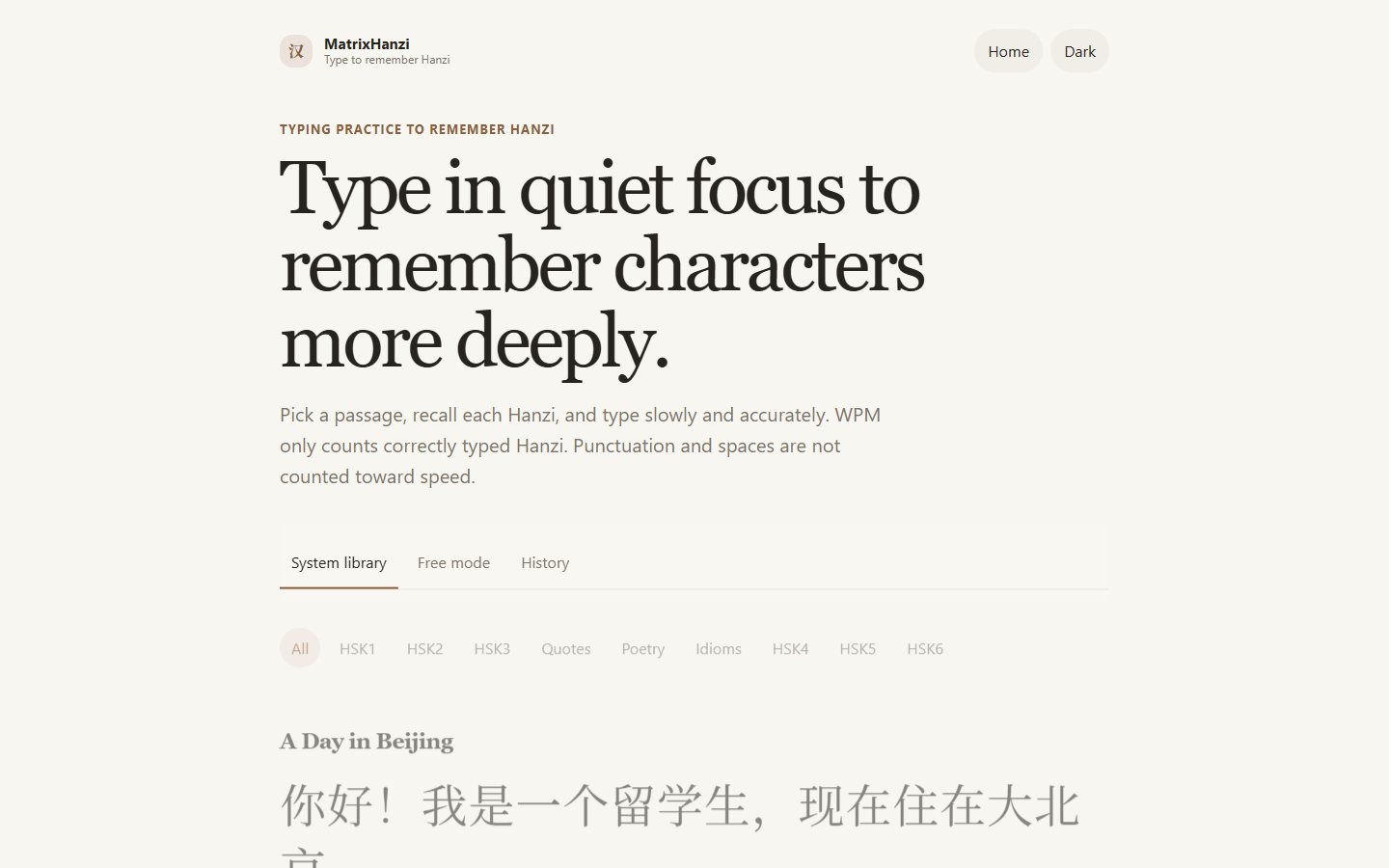
A small detail that says a lot: in Typing mode, WPM counts only correctly typed hanzi. Typing fast but wrong earns nothing. The philosophy lives right inside the metric: real speed is the speed of accuracy, not the speed of your hands.
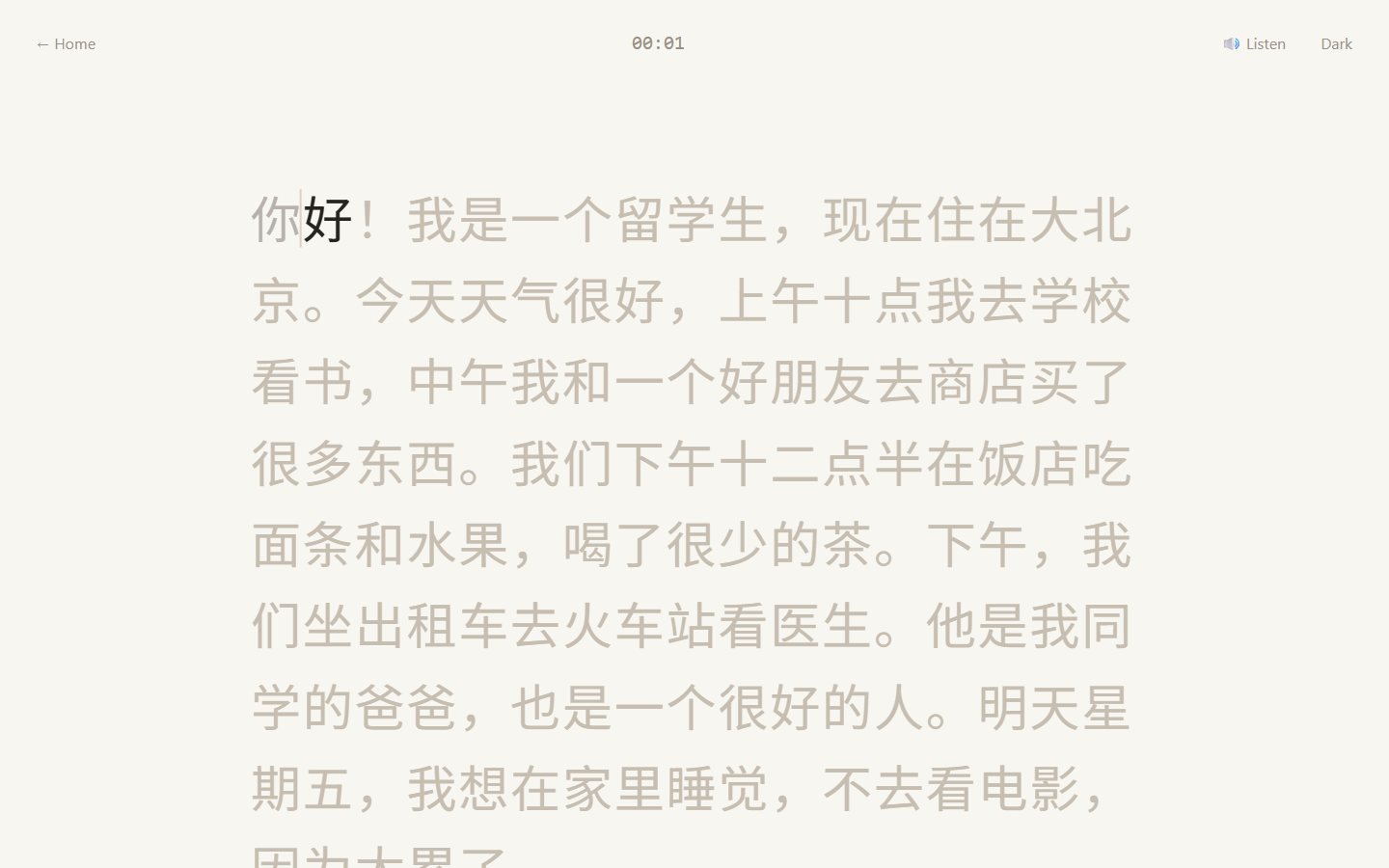
And typing here is not just for reviewing single words: you can save your own writing — a poem, a few diary lines, a letter — and type that very text back. When the content is yours, Tier 3 (production) gets trained at the same time as Tier 2: you are retyping sentences you once thought up in Chinese.
4. The matrix of six recall directions
A memory with only one entrance breaks when that entrance is blocked. So this philosophy doesn't stop at typing: it multiplies recall across six directions, each mode a different cue for the same knowledge record:
Put together, the six cues form a matrix: the same character 爱, recalled by eye (flashcards), by hand (typing), by ear (listening and choosing), by voice (speaking), by structure (爫 + 冖 + 友 — a hand sheltering a heart), by context (a sentence in a passage). A memory with six strands is harder to break than a memory with one — that's not a metaphor, that's how semantic memory works.
 爱
爱
5. A week lived by this philosophy
30 new items in Learn & Analyze: read the construction and the mnemonic, mark the characters that feel hard to anchor.
Flashcards over the same range: flip, listen, look at the line art; mark any character that stalls you.
Deep Memory from the "Marked" source: type everything back, no skipping.
A few rounds of Fast Reflex: ear, eye, and hand have to catch up with each other.
Typing: type a passage containing the week's words (or your own saved text).
Speaking: read that passage aloud; fix your tones with the feedback.
Home → "Errors" source → a short Deep Memory round. Next week starts from exactly this list.
Seven days, one direction of recall per day, and one day to close the loop. No day runs past twenty minutes. That's not an ascetic training schedule — that's the philosophy translated into a timetable.
6. Conclusion
The keyboard is not a piece of technology that wandered into the study of logographic characters by accident. It is the most honest language-production device most of us own: every keystroke is a sworn statement that a memory is still there — or has already left. Set active recall as the engine, typing as the central ritual, and the six modes as six directions of recall — and you have a learning philosophy that runs not on motivation, not on the illusion of familiarity, but on evidence, repeated every day.
Don't ask how long you've studied.
Ask how much your keyboard can still type back.
Let the keyboard answer that question
Open a Deep Memory or Typing session right now. Ten minutes is enough — enough to find out which characters are still alive and which have become strangers.
Sources / notes
- Karpicke, J. D., & Roediger, H. L. (2008). The Critical Importance of Retrieval for Learning. https://learninglab.psych.purdue.edu/downloads/2007/2007_Karpicke_Roediger_JML.pdf
- Roediger, H. L., & Butler, A. C. — The critical role of retrieval practice in long-term retention. https://www.sciencedirect.com/science/article/abs/pii/S136466131000207X
- Bjork, R. A. — Desirable Difficulties. https://en.wikipedia.org/wiki/Desirable_difficulty
- Typing speed statistics. https://fastfingers.net/typing-speed-statistics