The question this article answersHow can I stay consistent learning Chinese?
Short answerTo stay consistent, replace inspiration-dependent study with a realistic routine you can repeat. Use discipline to begin when motivation is low, build habits that reduce daily decisions, and judge progress through recall rather than activity.
Learning a new language has never been a light journey. With Chinese, it’s more like walking into an ancient city: beautiful, deep, layered with meaning — and more than capable of overwhelming a newcomer with hanzi, tones, and an entirely different way of thinking. The good news is that this road requires no special talent. It requires something more ordinary, and rarer: consistency.
1. The hard truth: feeling like you’re learning is not progress
So many people start on a wave of excitement: buying books, downloading apps, saving dozens of videos, setting enormous goals. A few weeks later, the novelty runs out. When learning turns repetitive and demands real effort, inspiration is the first to leave — and it leaves without notice.
At this point a vital distinction is needed: consuming content and training ability are two different things. Watching videos, underlining grammar, scrolling vocabulary lists — they all deliver the pleasant feeling that “I’m studying.” But without review, without use, without listening again, without building your own sentences, without typing them out yourself, language ability is barely being built at all. The fluency illusion you feel when re-reading an answer is the most familiar mirage in language learning.
Language is a skill.
And skills don’t grow on inspiration — they grow on deliberate repetition.
2. Discipline is the bridge that leads to habit
Discipline isn’t being harsh with yourself. Discipline is setting rules that protect long-term goals from short-term feelings: still reviewing for 15 minutes when you’re tired, still listening to a passage when you’re not in the mood, still typing out the weak group when you already want to close the laptop. Each time, you send your brain one signal: this matters.
Phillippa Lally and colleagues’ habit-formation research shows that when a behavior is repeated in the same context, its automaticity rises steadily — and the time needed to reach a high level of automaticity varies enormously between individuals, from 18 to 254 days. The pragmatic message: don’t ask “when will this become a habit?” Ask “what context will trigger this every day?” — the same hour, the same spot, the same opening move.
And this is where product design becomes discipline’s ally. A habit only survives when friction is small enough:
3. No environment? Build an artificial one
Not everyone can move to China to immerse themselves in Chinese. But “no environment” is not a full stop — it is a design problem. An artificial environment is a set of small, steady touchpoints that make the language show up in your day wherever you are:
Here’s the fun part: Matrix Hanzi’s six modes happen to match the six energy states of an ordinary day. A sustainable artificial environment doesn’t demand that you grind every single day — it needs a door that fits each kind of day:
Discipline of this kind doesn’t ask you to be a hero every day. It asks you to show up every day — in whatever form you can.
4. With Chinese, systematic learning matters even more
Chinese rewards the people who see structure. Thousands of hanzi are not thousands of random drawings — they are assembled from components that carry meaning and sound. Learning characters by radicals and components significantly reduces the memory load compared with rote-learning stroke by stroke.
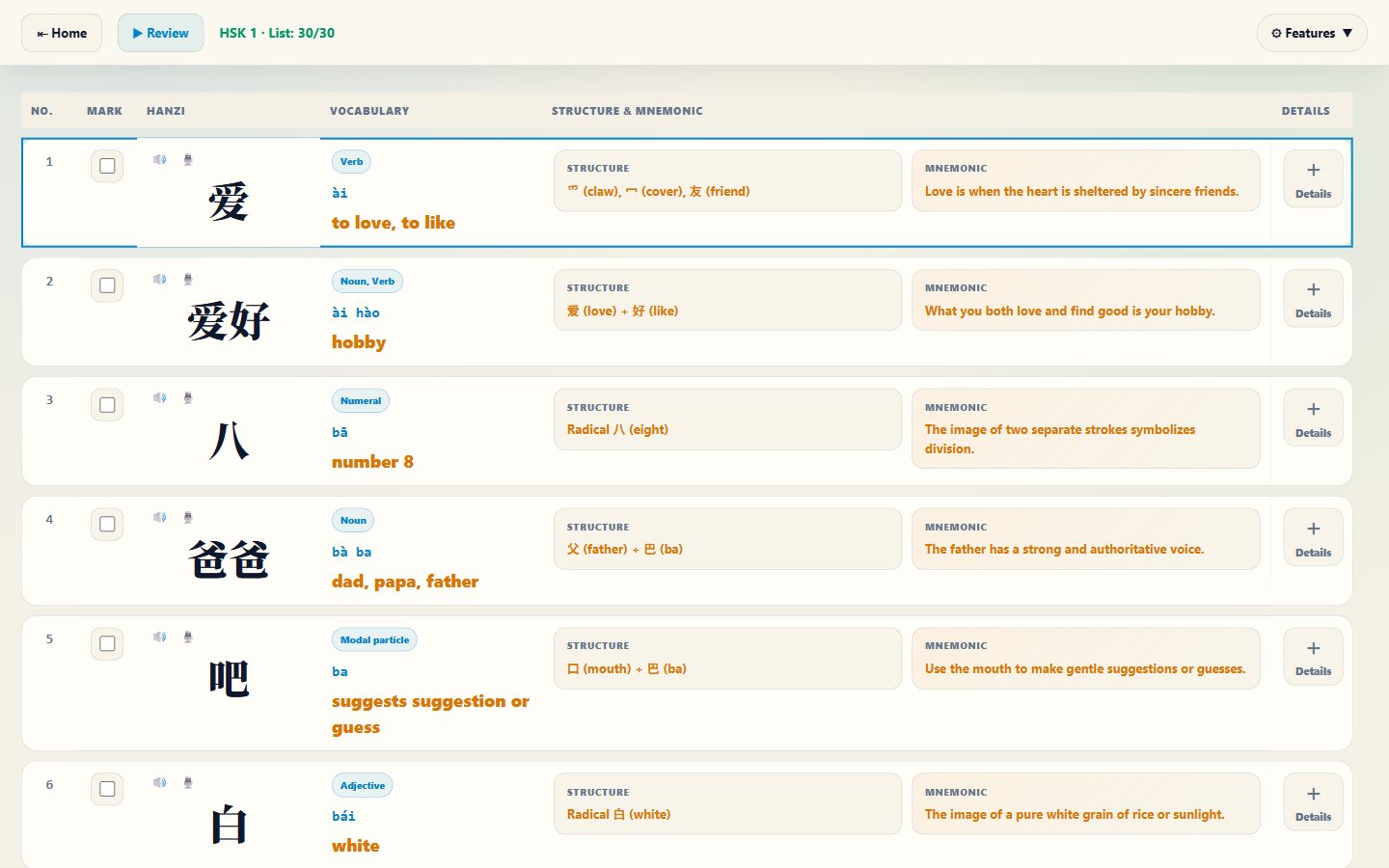
And this is where Matrix Hanzi’s data does the heavy lifting for you: every knowledge object comes with Composition and Mnemonic fields. Take the character 比 at HSK 1:
 比
比
One well-placed mnemonic story is worth ten punishment copy-lines: it turns an abstract shape into a scene you can picture. Multiply that across more than 16,800 vocabulary entries, 3,008 idioms with origin stories, and over 33,000 sentence patterns with analysis — that is no longer rote learning, that is learning with a map.
5. A realistic roadmap for learners without ideal conditions
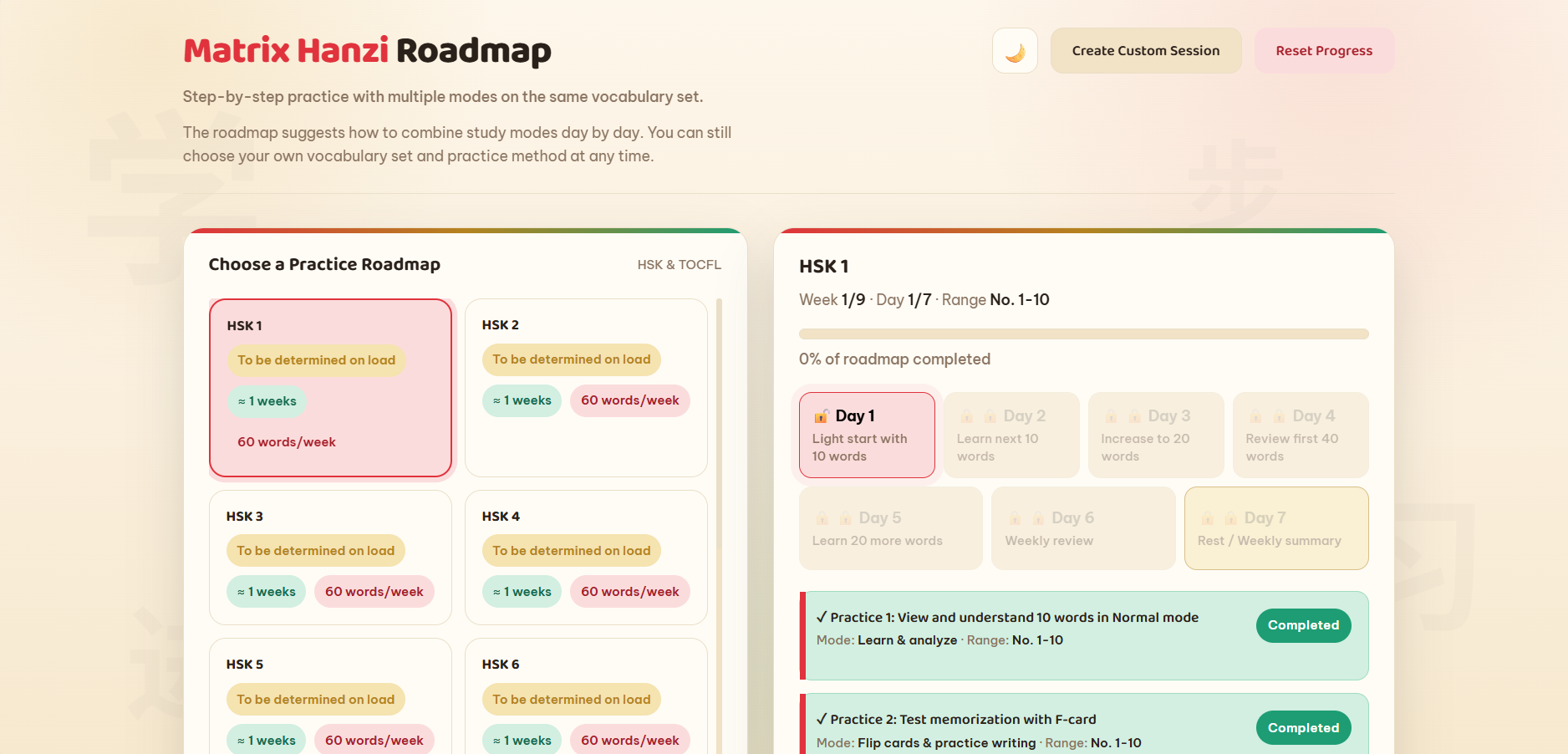
Here is the framework for your first seven days — in the exact spirit of the Suggested Roadmap inside the product: combining multiple modes, one focus per day, progress saved on your own machine.
Go to Home, pick HSK 1 (or the set that fits you), scope of 30 items. Open Learn & Analyze and slowly read the first 10 with their composition and mnemonic.
Flashcard with that exact scope: flip, listen, look at the line-art; mark the uncertain characters.
Deep Memory with the marked group: type them all out, no skipping.
A few rounds of Fast Reflex: measure whether your ear and your eye have caught up with each other.
Switch to sentence patterns at the same level: read the structural analysis, then type the sentences in Typing.
Speaking: read 5–10 sentences aloud; hear the tone feedback and correct them a second time.
Back to Home, choose “Mistakes” as the data source, and run one Deep Memory loop to close the week.
At the end of seven days, you have more than 30 firmer characters. You have a habit in formation, an honest set of mistakes, and a body that already knows the way back to the harbor every day. From week two, just repeat the framework with a new scope — the habit will carry the weight.
6. Conclusion
Chinese isn’t hard the way an unscalable wall is hard. It’s hard the way a long road is hard: walk it daily and it opens up; stand and stare and it stays a distance forever. You don’t need to be perfect from the start — you need a system good enough to keep you with this language long enough: discipline to start again every day, habit so that starting again costs no willpower, and a data harbor so that no effort washes down the river.
Inspiration opens the door.
Discipline keeps you on the road.
Habit carries you to the destination.
Start your first seven days today
Open the Suggested Roadmap, or build your first 30-item session at Home. Tomorrow, that very dataset will be waiting for you — no reconfiguring needed.
Sources / notes
- Lally, P. et al. (2009). How are habits formed: Modelling habit formation in the real world. https://repositorio.ispa.pt/bitstream/10400.12/3364/1/IJSP_998-1009.pdf
- Fortune, T. W. — Immersion Research Review (CARLA, Univ. of Minnesota). https://archive.carla.umn.edu/immersion/documents/ImmersionResearch_TaraFortune.html
- Radical Awareness Among L2 Chinese Learners. http://journal.tcsl.ntu.edu.tw/volumes/2/Radical%20Awareness%20Among%20L2%20Chinese%20Learners.pdf
- Using Radicals in Teaching Chinese Characters to L2 Learners. https://repository.eduhk.hk/en/publications/using-radicals-in-teaching-chinese-characters-to-second-language-/