The question this article answersWhat does discipline mean in Chinese learning?
Short answerDiscipline in Chinese learning is not forcing yourself through endless study. It means creating boundaries that protect your long-term goal when your mood changes, so one difficult day does not quietly end your progress.
Learning Chinese isn't hard the way an unclimbable wall is hard. It's hard the way a long road is hard: walk it every day and it opens up in front of you; just stand and stare at it and it stays a distance forever. And what decides whether you walk it every day is rarely talent — most learners don't lack talent. What they lack is a system durable enough to repeat, review and use Chinese every single day, including the days when there isn't a shred of inspiration to be found.
1. Why do so many people study for years and still not progress?
Because they study to feel like they're learning, not to actually build ability. Finishing a video doesn't mean you've remembered anything. Copying out a vocabulary list doesn't mean you can summon those words when you need them. That sense of fluency you get from re-reading the answers is the most pleasant illusion in language learning — and the most expensive one.
You don't forget Chinese characters because you're bad at this.
You forget because you haven't had enough well-timed re-encounters yet.
"Well-timed re-encounters" — those three words are the entire problem. Memory doesn't need you to love it; it needs you to keep coming back. And to keep coming back over months on end, you can't rely on inspiration. You need a structured promise: discipline.
2. Discipline is a fence, not a whip
Let go of the image of discipline as a foreman cracking a whip. Understood correctly, discipline is the set of rules you give yourself to protect a long-term goal from short-term moods — tonight's tiredness, tonight's episode, tonight's invitation out. It doesn't push you to run faster; it keeps your garden from being trampled.
Discipline
Doing what needs to be done even when you don't want to.
Gets you started and keeps you on the rails on days when your mood sinks.
Habit
An action repeated long enough that it has become natural.
Carries you a long way without charging a willpower fee every day.
Discipline is the bridge; habit is the far bank. What few people tell you is this: the bridge only holds its load if it is within your capacity. A promise of "two hours a day" is an overloaded bridge — it collapses in week three, and the collapse takes your confidence with it. A promise of "fifteen minutes, same time, same spot" is a bridge anyone can cross — including you on your very worst day.
3. A system that absorbs your moods
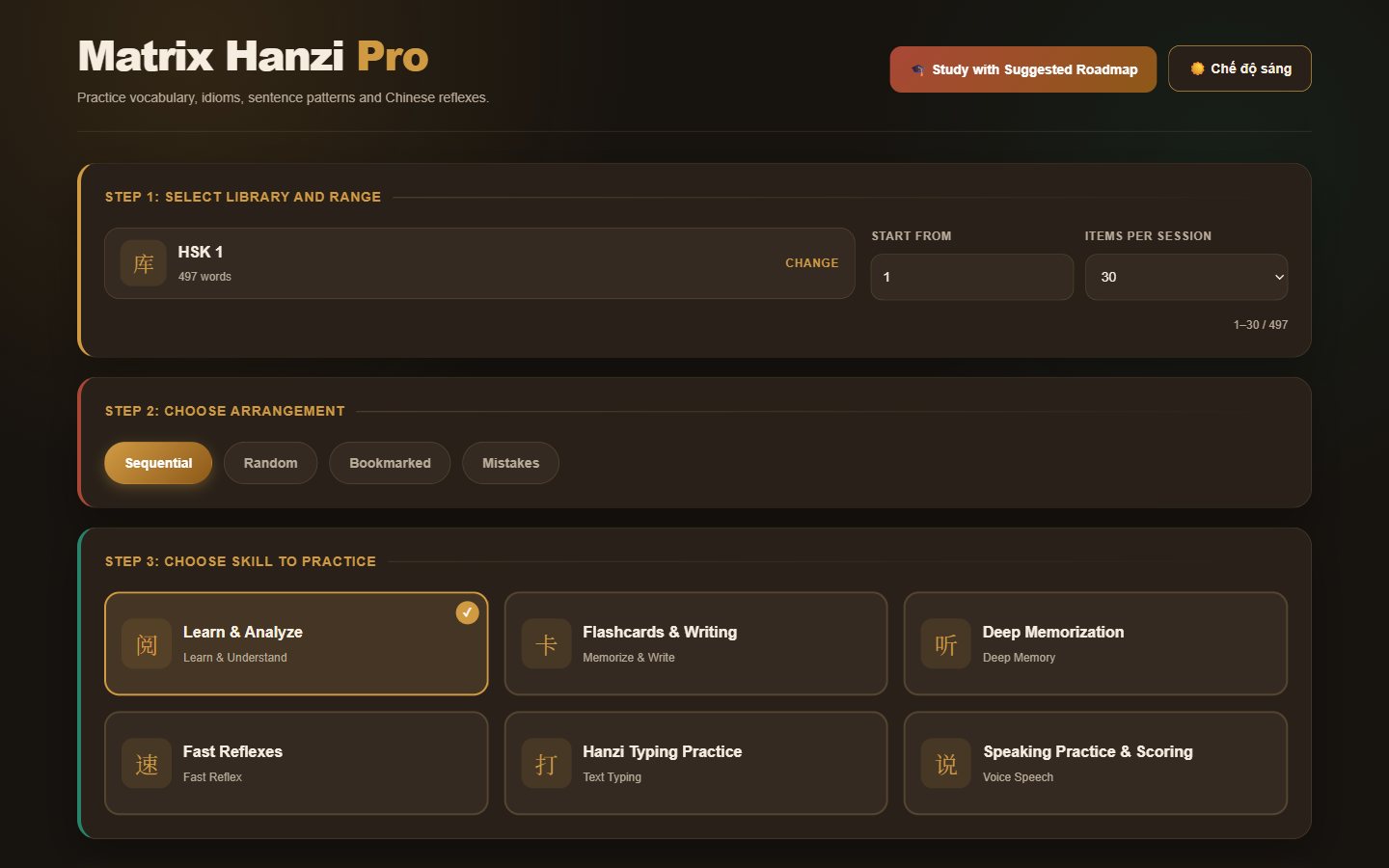
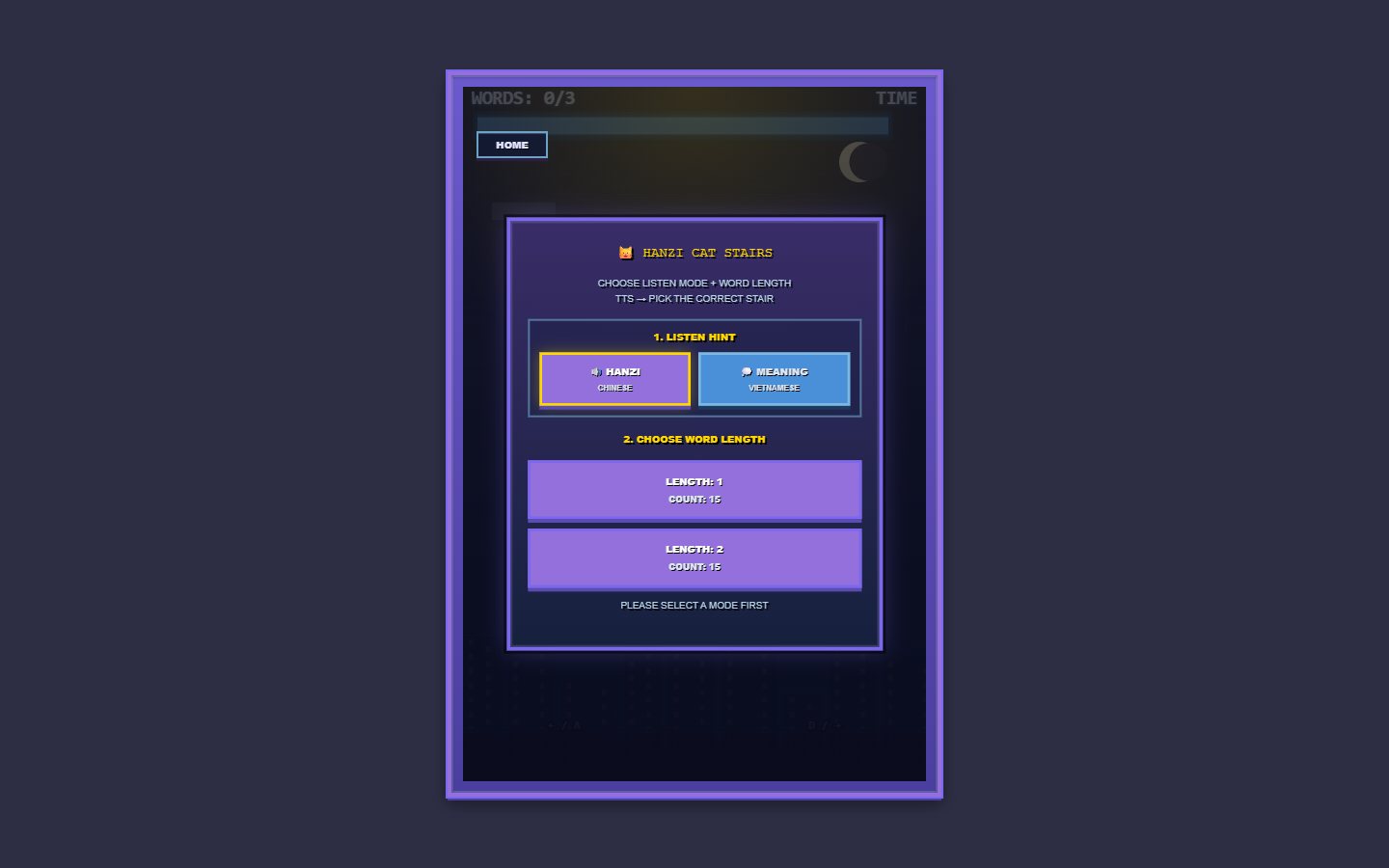
This is where a good tool separates itself from empty advice. Empty advice says: "just stay consistent." A good system asks: "how do you feel today, and which door fits you?" Matrix Hanzi is organized around six modes — and whether by accident or by design, those six modes cover nearly the whole energy spectrum of an ordinary learner:
Notice what this system doesn't demand: it never asks you to be excited every day, to sit up straight for two hours, or to finish the syllabus. It only asks you to show up — in any one of those six forms. A tired day with ten cards flipped still keeps your memory pathways warm. Ten days like that add up to something no single enthusiastic study session can ever buy: continuity.
Fence-style discipline never asks "how strong are you today?"
It asks "which door fits you today?" — and then keeps you inside the garden.
4. An artificial environment: the lamp left on each evening
Not everyone can step into a real Chinese-speaking environment. But an artificial one is something anyone can build — out of small touchpoints repeated in the same context, which is exactly the habit-formation mechanism Lally's research describes: behavior repeated in a stable context gradually becomes automatic.
And because discipline only lasts when friction stays small, the "open the door" part of an artificial environment has to be nearly free too: no login, no installation, no reconfiguring anything every day. Open the browser and yesterday's dataset is still right there — the scope intact, the marked characters intact. The lamp doesn't need you to relight it from scratch; it only needs you to walk in and sit down.
5. What does a durable learning system need?
Nothing complicated. Just clear enough that tomorrow you know exactly what to do without having to think about it:
6. Conclusion
If you're learning Chinese for your future — the job, the opportunities, the stability, or simply a better version of yourself — then you can't learn it half-heartedly. But you also don't need to punish yourself in order to progress. What you need is a fence: low enough to step over every day, solid enough to keep the short-lived storms outside. You don't have to be perfect from the start. You need a system good enough to keep you with this language long enough — long enough for the habit to take hold, for the characters to put down roots, for the long road to open up beneath your feet on its own.
Learn hanzi with a system, not just with inspiration.
And let discipline be the one who tends the lamp — not the one holding the whip.
Tonight, leave one lamp on
Fifteen minutes, one mode that fits how you feel, and yesterday's dataset still waiting for you. Tomorrow, fifteen minutes again. The garden takes care of most of the growing by itself.
Sources / notes
- Lally, P. et al. (2009). How are habits formed: Modelling habit formation in the real world. https://repositorio.ispa.pt/bitstream/10400.12/3364/1/IJSP_998-1009.pdf
- Roediger, H. L., & Karpicke, J. D. (2006). Test-Enhanced Learning. https://learninglab.psych.purdue.edu/downloads/2006/2006_Roediger_Karpicke_PsychSci.pdf
- Fortune, T. W. — Immersion Research Review (CARLA). https://archive.carla.umn.edu/immersion/documents/ImmersionResearch_TaraFortune.html