There's a scene familiar to almost every language learner: ten browser tabs, three phone apps, a stack of paper flashcards, a few homemade Excel files. Each one solves a piece of the learning problem — and that very fragmentation is why none of them ever goes deep enough. Matrix Hanzi started from the opposite question: what if everything lived in one workspace?
1. From a typing-practice page to a house with six rooms
The first version of Matrix Hanzi was far humbler than what exists today: a hanzi typing-practice workspace where you typed out vocabulary to train recall. It was right, but it was small. Learners need more than a single door: they need to understand how a character is built before they can remember it, they need to hear the sounds, they need to speak them out loud, they need speed, they need context.
The current version keeps the old soul — one place, one data stream — but opens the house out into six rooms. And here's the crucial part: those six rooms are not six separate apartments. They share the same active dataset, the same marking state, the same mistake history, the same progress saved on your machine.
2. One dataset, six workstations
Each mode is a different workstation set around the same stack of documents:
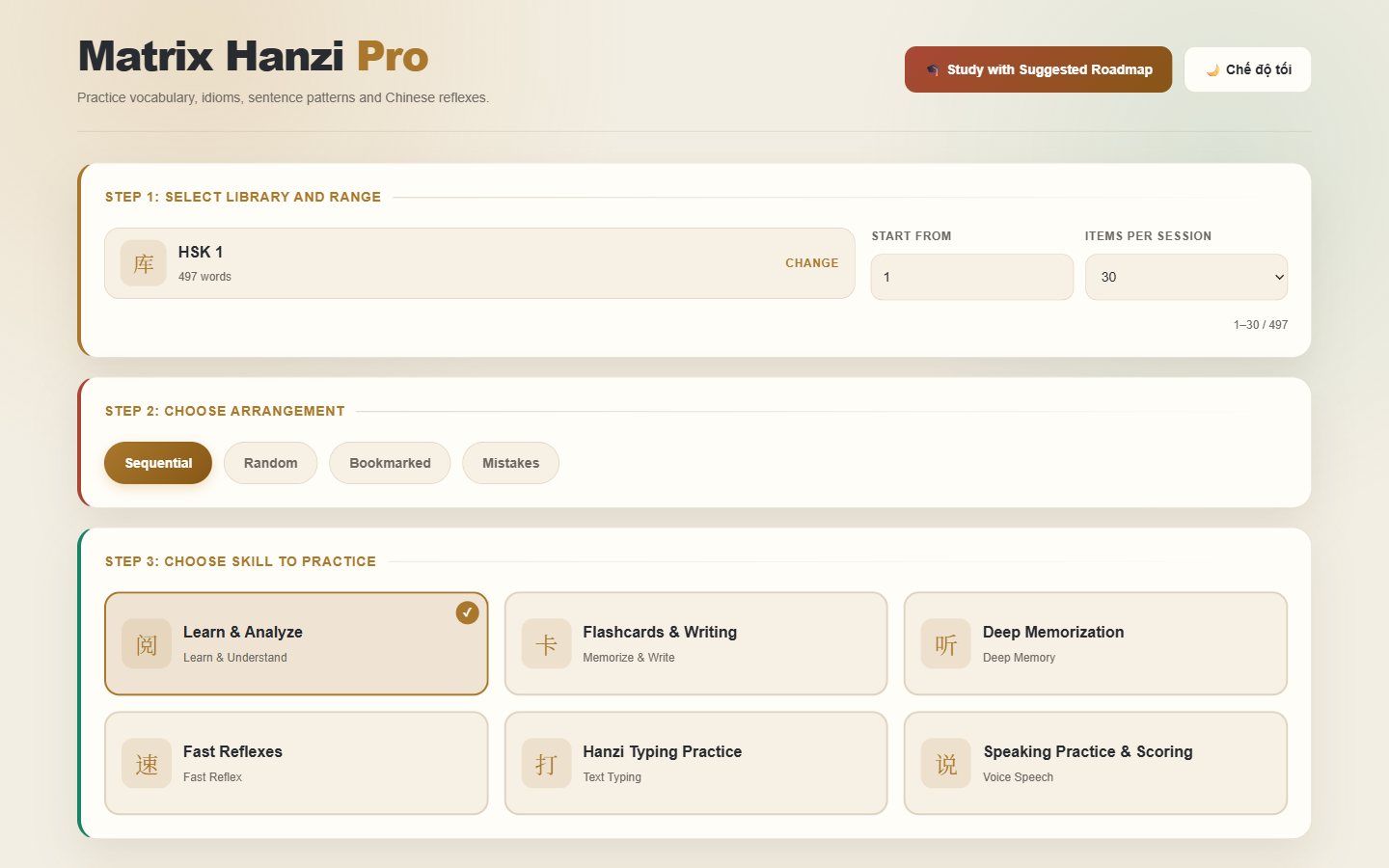
The payoff of a "one dataset – many modes" architecture isn't surface-level convenience. It's that your learning state never fragments: a character you marked at the reading desk is waiting for you at the drill desk; a mistake you made at the drill desk becomes a list at the speed desk. There's no second card deck to keep in sync, no Excel file to update by hand.
3. For every learner
A workspace only deserves to be called shared if it can hold both the newcomer and the person who has already come a long way. The current library spans a very wide spectrum:
A beginner picks HSK 1 with a scope of 30 items per session. An exam candidate picks traditional-script TOCFL. Anyone who wants characters "with a soul" picks idioms — each one comes with its literal meaning, figurative meaning, usage and backstory, like 白衣蒼狗, which borrows the image of white clouds shifting into the shape of a gray dog from Du Fu's poetry to speak of life's impermanence. And anyone who needs complete sentences picks sentence patterns, each analyzed component by component with a structural template you can use to build new sentences yourself.
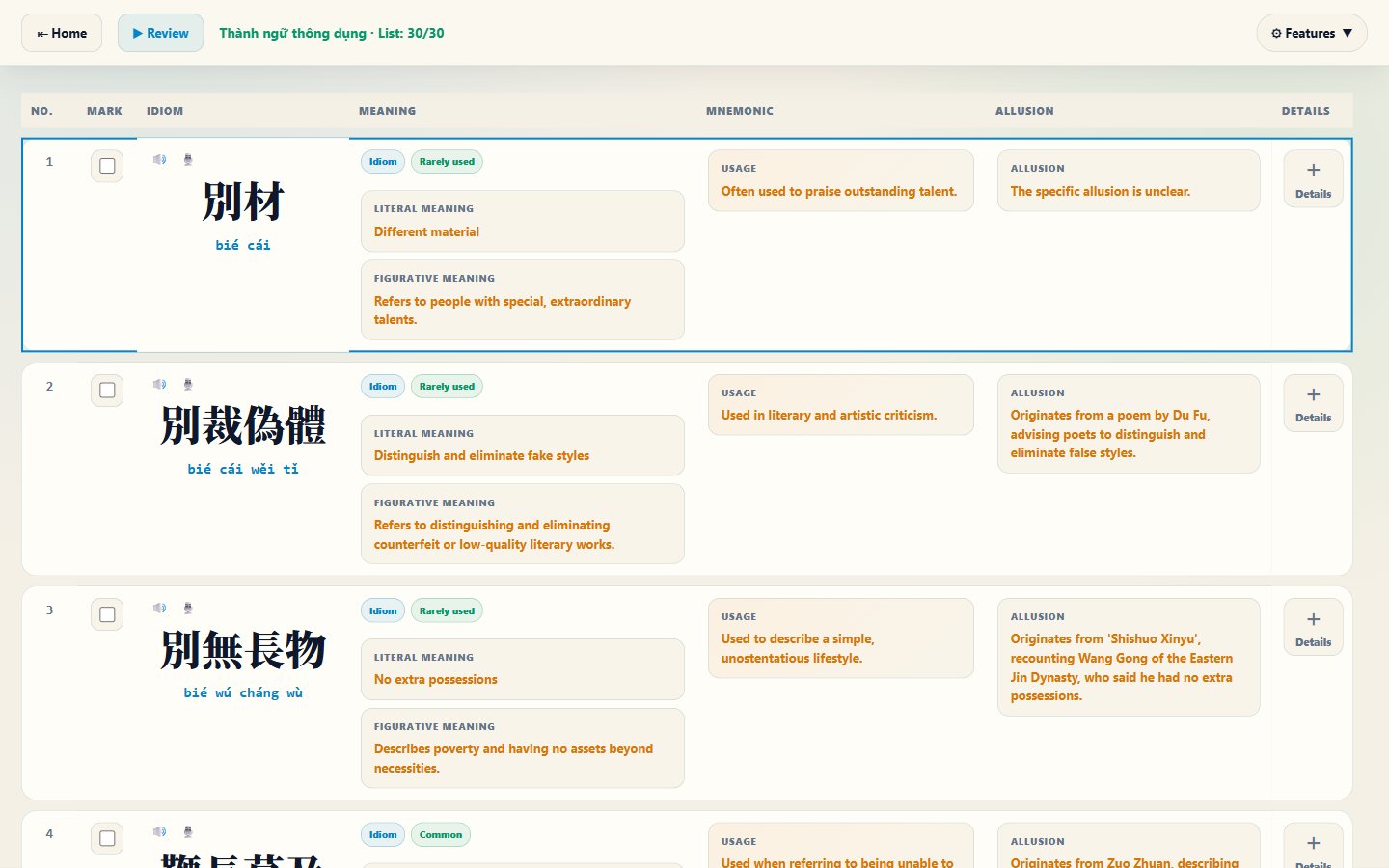
And because you set each session's scope yourself, the same library serves both a 10-minute study break and a 200-item grind. The workspace never asks "what level are you?"; it asks "how far do you want to go today?"
4. For every language
That may sound like an overstatement when the current product is all about Chinese. But look at what actually makes the workspace: not the hanzi themselves, but the knowledge-object architecture. Every data item is a clearly structured record — written form, transcription, meaning, part of speech, composition components, mnemonic story, compounds, examples, image, audio. The modes are simply different ways of questioning that same record.
Here's the proof that this architecture isn't chained to one writing system: within Chinese alone it already serves two parallel scripts — simplified for HSK and traditional for TOCFL — plus four-character idioms and long sentences with full syntactic analysis. Three very different kinds of content, one data pipeline, the same six modes.
To put it plainly: today this workspace speaks Chinese. But the schema underneath it — knowledge records plus recall modes — has no nationality. That's why the title of this article dares to say "every language": not as a promise about tomorrow, but as the direction the architecture is already pointing.
One more layer of openness is in your own hands: the Typing and Speaking modes accept content you write yourself. A poem you love, a few sentences you composed, a letter never sent — the workspace takes in even the things that live in no library at all.
5. The workspace is yours — no account needed
The personalization here doesn't come from a profile server; it comes from the traces you leave on your own machine:
6. Conclusion
Ten tabs won't make you good at Chinese. One place deep enough might. Matrix Hanzi takes the road opposite to most apps: instead of piling on features to keep you inside the app, it gathers everything you need around a single data stream — so every minute you invest compounds into the same memory, the same reflexes, the same learner.
One workspace.
Every level.
And an architecture with no language borders.
Close the tabs, come in through one door
Pick your first library at Home and walk through all six rooms this week. You'll find out which room is yours.
Sources / notes
- Matrix Hanzi product profile — describing the six modes and the knowledge-object structure.
- Sweller, J. — Cognitive Load Theory: reducing load through structured information organization. https://en.wikipedia.org/wiki/Cognitive_load_theory
- Roediger, H. L., & Karpicke, J. D. (2006). Test-Enhanced Learning. https://learninglab.psych.purdue.edu/downloads/2006/2006_Roediger_Karpicke_PsychSci.pdf