The question this article answersHow can I remember Chinese words learned anywhere?
Short answerYou can learn Chinese from apps, videos, classes, conversations, and daily life, but new words need one place to return to. Collect them in a shared review system and retrieve them regularly through active recall.
Today’s Chinese learner has no shortage of options: classes, textbooks, apps, online courses, films, comics, podcasts, Douyin, YouTube, dictionaries, HSK practice tests. You might meet the word 努力 in a drama, hear it on a podcast, and copy it into a notebook. But one very large question remains, and almost nowhere answers it for you:
After you’ve learned it, how do you not forget it?
This article isn’t trying to persuade you to abandon the places where you already learn. It is about the missing piece of the picture: a place to remember.
1. The real problem: no shortage of places to learn — a shortage of places that help you remember
A common mistake is equating progress with the number of new words loaded in. But the more you learn, the more characters you have to keep — and without a regular review system, the words you learned a few weeks ago quietly walk out of your memory, without fanfare. You don’t notice the forgetting until the day you need them.
Cognitive psychology calls the act of pulling information out of memory retrieval practice or active recall, and the testing effect shows: recalling on your own doesn’t just measure memory — it creates long-term memory. The catch is that retrieval practice needs a place to happen every day. Not a place that explains more. A place that asks you: this character — can you still call it out yourself?
Looking back is not the same as remembering.
Recognizing is not the same as being able to type it out.
2. “Learn anywhere” now has two layers of meaning
When this article first appeared, “learn anywhere” meant: learn from whatever source you like, then bring the list into a workspace to review. Matrix Hanzi has since grown far beyond that, and the phrase has gained a second layer.
Layer 1 — Any learning source works
Matrix Hanzi’s system libraries now include three structured content groups: simplified HSK and traditional TOCFL vocabulary (over 16,800 entries), 3,008 idioms with literal meaning, figurative meaning, usage, and origin stories, and more than 33,000 sentence patterns with structural analysis. Each entry is not a line of text — it is a knowledge object: character composition, mnemonic story, compounds, and examples with pinyin and English meanings.
Layer 2 — Any mode works, because there is only one dataset
The most important thing about the new version: you choose the dataset once at Home, and that dataset — the Active Dataset — follows you through all six modes. Not six separate lists. One harbor, six roads.
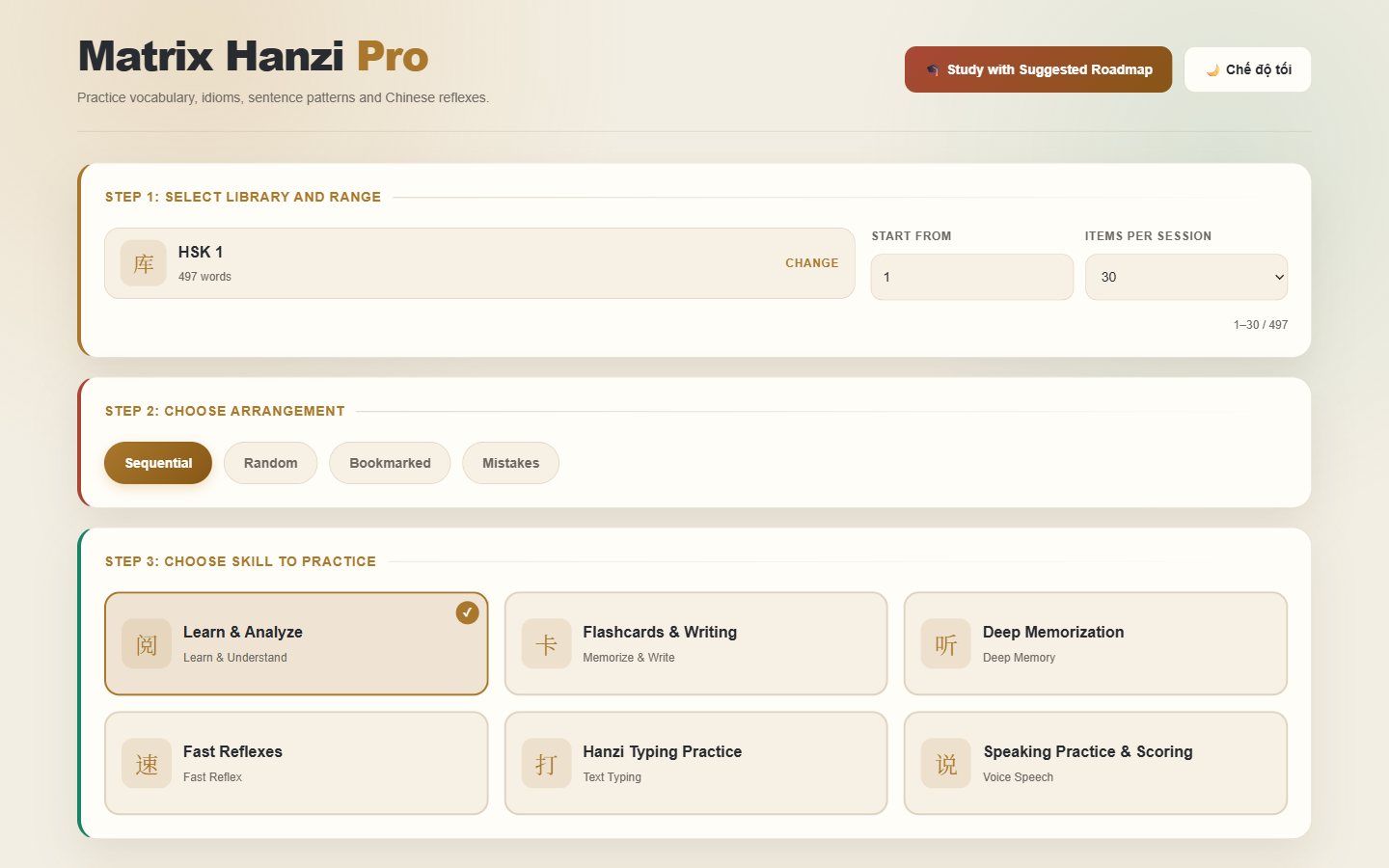
That means the word 努力 you analyzed this morning in the data table is the same word on the card you flip at noon, the word you must type out this afternoon, the word that sounds out in tonight’s mini-game — the same record, the same marked state, the same mistake history. Memory is no longer split up by tool.
3. The harbor of memory: marked and mistakes
Imagine every character is a ship. By day it sails: met in a film, in a reading, in class, on a flashcard. But a ship can’t drift forever — it needs a harbor to return to, to drop anchor, to be inspected and maintained. In Matrix Hanzi, that harbor has two piers:
Marked
Any character that feels “not yet sure” — mark it right in the analysis table or while flipping cards. No notebook, no third note-taking app.
Marking is a promise: “this character, I will come back to it.”
Mistakes
Every mistype in Deep Memory, every missed answer in Fast Reflex, is gathered automatically.
Mistakes are facts created by your own hand — so they are more accurate than any prediction.
And here the circle closes: at Home, you can set the fetch method to Marked or Mistakes. Your next session will contain only the ships that just came into port — your weakest, freshest characters, the ones most in need of anchoring. Not one minute burned on characters you have known cold for ages.
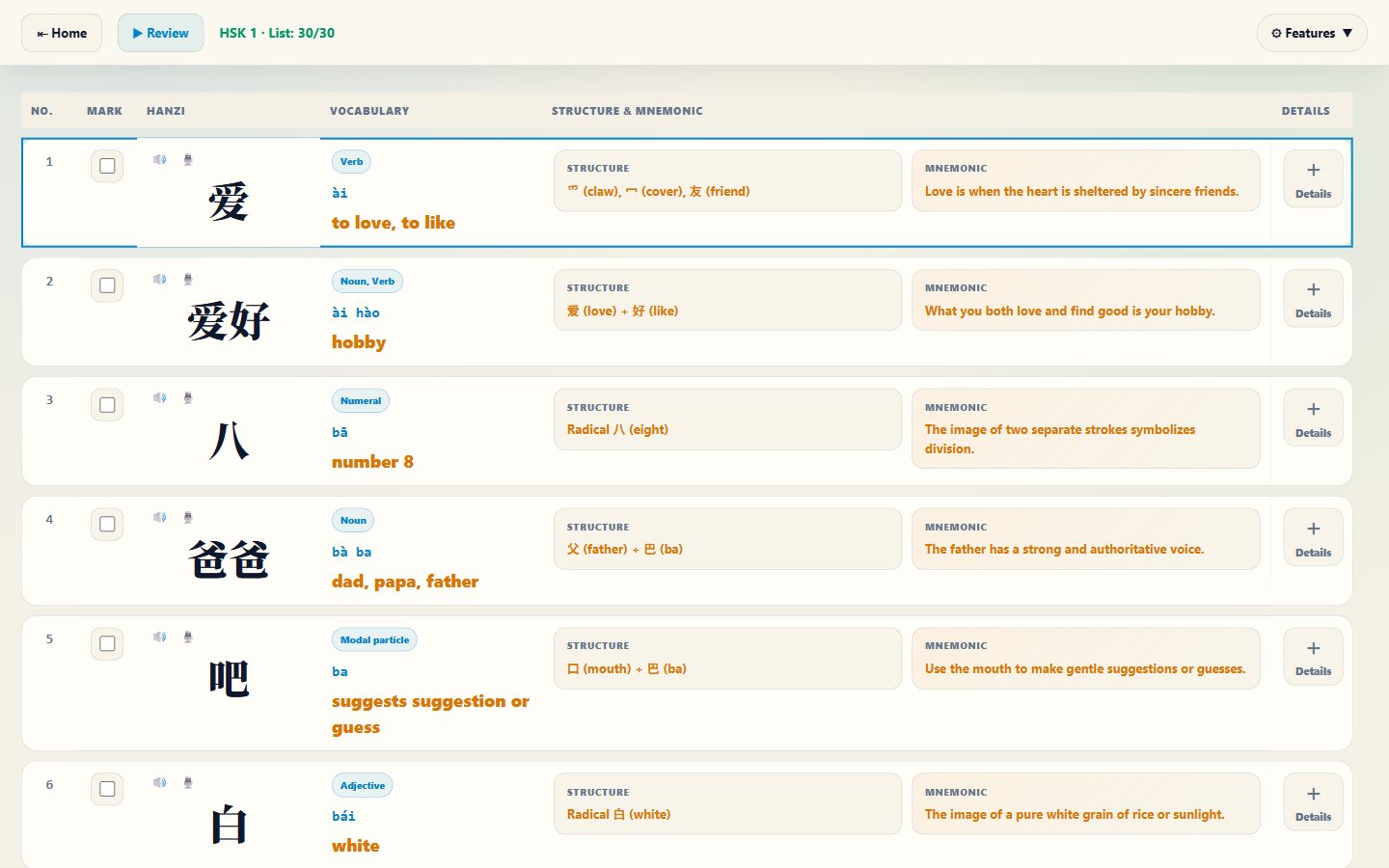
How is this different from “making your own flashcards”? Because you never have to manage a second card deck. The weak/strong state is born naturally from the learning process itself, and Home turns it into a session with a single choice.
4. Typing remains the backbone of review
Among the ways to call a memory back, typing holds a special place: it forces the brain to produce, not just recognize. Seeing 努力 and nodding “ah, effort” is recognition. Typing out 努力 yourself from the clue “effort” is recall — and recall is what works when you’re writing a message, drafting an email, answering a partner.
Simple math explains why typing wins at scale: the average user types around 40 WPM (standardized at 1 word ≈ 5 characters). With hanzi, each word averages 2 characters — meaning one steady minute of typing can touch dozens of items. A 10-minute Deep Memory session cleanly processes several hundred recalls — something handwriting can never catch up with.
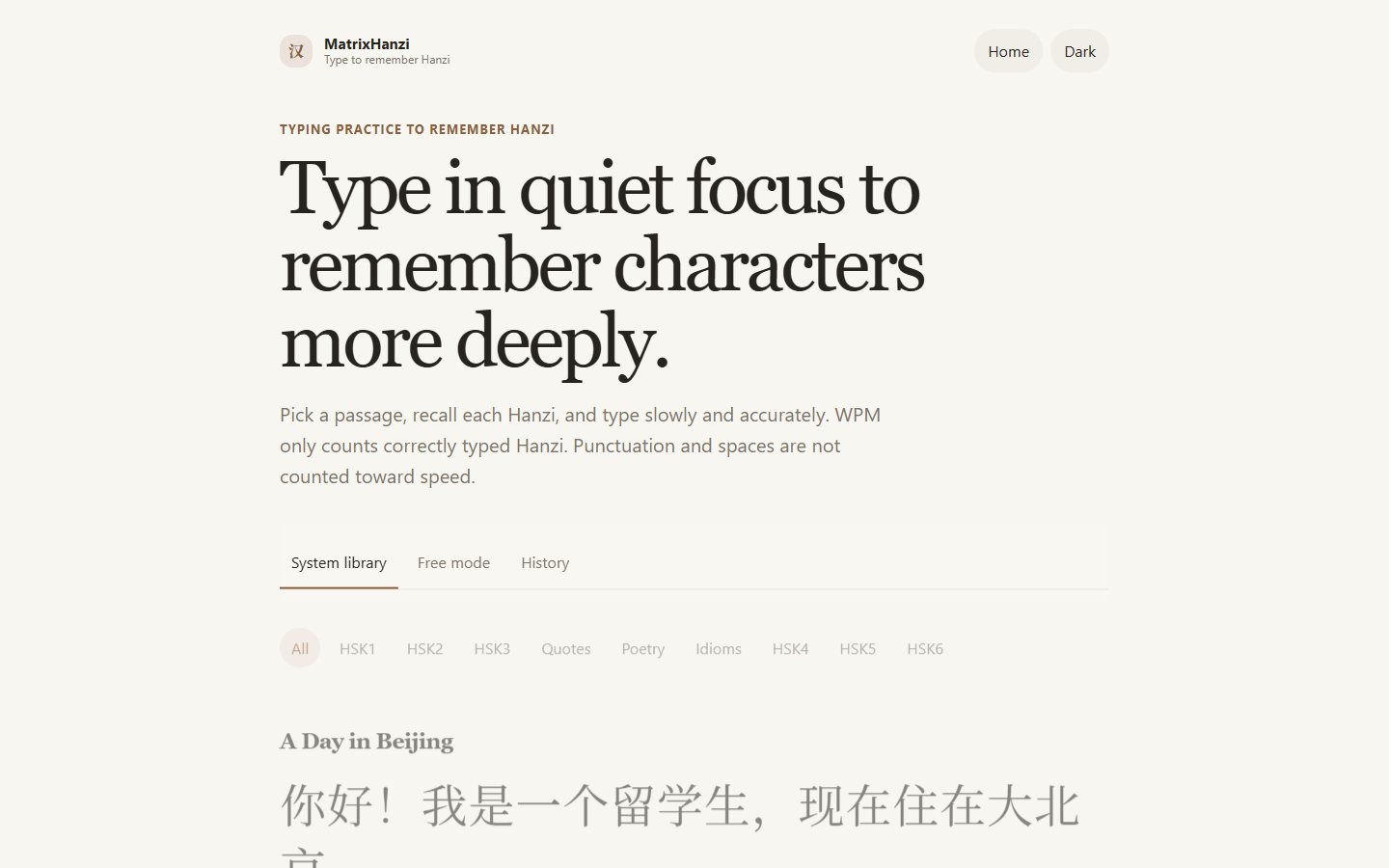
And if you want to review with your own content — a poem, a proverb, a few lines of a Chinese journal — Typing mode lets you save text you wrote yourself and practice on it. The harbor doesn’t only receive the system’s ships; it receives the ones you built with your own hands.
5. Where does Matrix Hanzi sit in your learning flow?
To be perfectly clear: Matrix Hanzi doesn’t try to replace your class, your textbook, your dictionary, or your entertainment apps. It stands at a different position in the flow — the position most people leave empty:
Class, films, podcasts, books, textbooks. Wherever you first meet a character, it counts.
Pick the right library (HSK/TOCFL, idioms, sentence patterns), or practice your own content in Typing and Speaking.
Flashcard to scan, Deep Memory to forge, Fast Reflex to measure speed, Typing to go deep, Speaking to make it audible.
Marked items and mistakes automatically become your next session. The review loop sharpens itself against your real weak points.
Those four steps don’t require you to change how you currently learn. They only add a single habit: stop by the harbor once a day.
6. Conclusion: don’t just learn more — forget less
There is a fairer measure of progress than words learned: words still remembered after three months. Learning more grows the numerator; review keeps the denominator from leaking. The good learner isn’t the one who loads fastest — it’s the one who drops the least.
Learn anywhere.
Look things up anywhere.
To remember — choose one harbor.
Chinese characters have already traveled with you through so many places. Don’t let them lose each other on the final leg. Give them a harbor: one dataset, one marked–mistakes loop, and fifteen minutes a day for every ship to be called by name.
Build your harbor in one minute
Choose a library at Home, start a Flashcard session, and mark your first uncertain characters. Tomorrow, Home will remember for you exactly where to return.
Sources / notes
- Roediger, H. L., & Karpicke, J. D. (2006). Test-Enhanced Learning. Psychological Science. https://learninglab.psych.purdue.edu/downloads/2006/2006_Roediger_Karpicke_PsychSci.pdf
- Karpicke, J. D., & Roediger, H. L. (2008). The Critical Importance of Retrieval for Learning. https://learninglab.psych.purdue.edu/downloads/2007/2007_Karpicke_Roediger_JML.pdf
- Structural Learning — Testing Effect & Retrieval Practice. https://www.structural-learning.com/post/testing-effect-retrieval-practice
- Typing speed statistics (average WPM). https://fastfingers.net/typing-speed-statistics