The question this article answersIs typing or handwriting better for learning Chinese?
Short answerTyping and handwriting train different skills. Stroke tracing helps learners notice and encode unfamiliar forms, handwriting develops written production, and typing provides efficient recall practice. The better method depends on the job you need to do.
Every few months, the Chinese-learning community reignites a familiar argument: must you handwrite a character a hundred times to learn it, or is handwriting a waste of time in the keyboard age? Both sides have a point; both sides are extreme. And both miss one thing: "learning hanzi" is not one job — it is at least three very different jobs.
1. The wrong question makes the wrong argument
"Is typing or handwriting better?" is an unanswerable question, because it merges three distinct goals into a single comparison:
The first time you meet a character: the hand needs to learn stroke order, the eye needs to get used to the shape, the head needs a story to anchor it. This is the job of the first encounter.
Hundreds of learned characters need regular recall so they don't fall away. This is the job of every remaining day — and by far the highest-volume job.
The few characters you love: writing them slowly on paper, feeling the hook and the sweep, hanging the page on your desk corner. This is the job of emotion, not of efficiency.
Comparing typing with handwriting without separating these three jobs is like asking "which is better, a car or a plane?" — it depends on whether you're going to the market or flying across a continent. Separate them, and the answer reveals itself:
Handwriting wins at Jobs A and C
The fine motor movement of the hand helps engrave a character's shape the first time, and delivers a savoring experience nothing else can replace.
But handwriting loses badly at scale: slow, hard to self-grade, hard to schedule for review.
Typing wins at Job B
Typing is many times faster than copying, gives instant right/wrong feedback, and review schedules build themselves from your marks and errors.
Job B occupies most of your lifetime of study time — so the tool for Job B determines your progress.
2. The engraving tier: stroke tracing for new characters
Research on motor movement and hanzi memory shows handwriting holds an advantage at the initial encoding stage: the hand moving through stroke order helps the brain record a character's shape more deeply than looking alone. Matrix Hanzi doesn't skip this tier — it puts the engraving tier in exactly the right place: right on the flashcard of the first encounter.
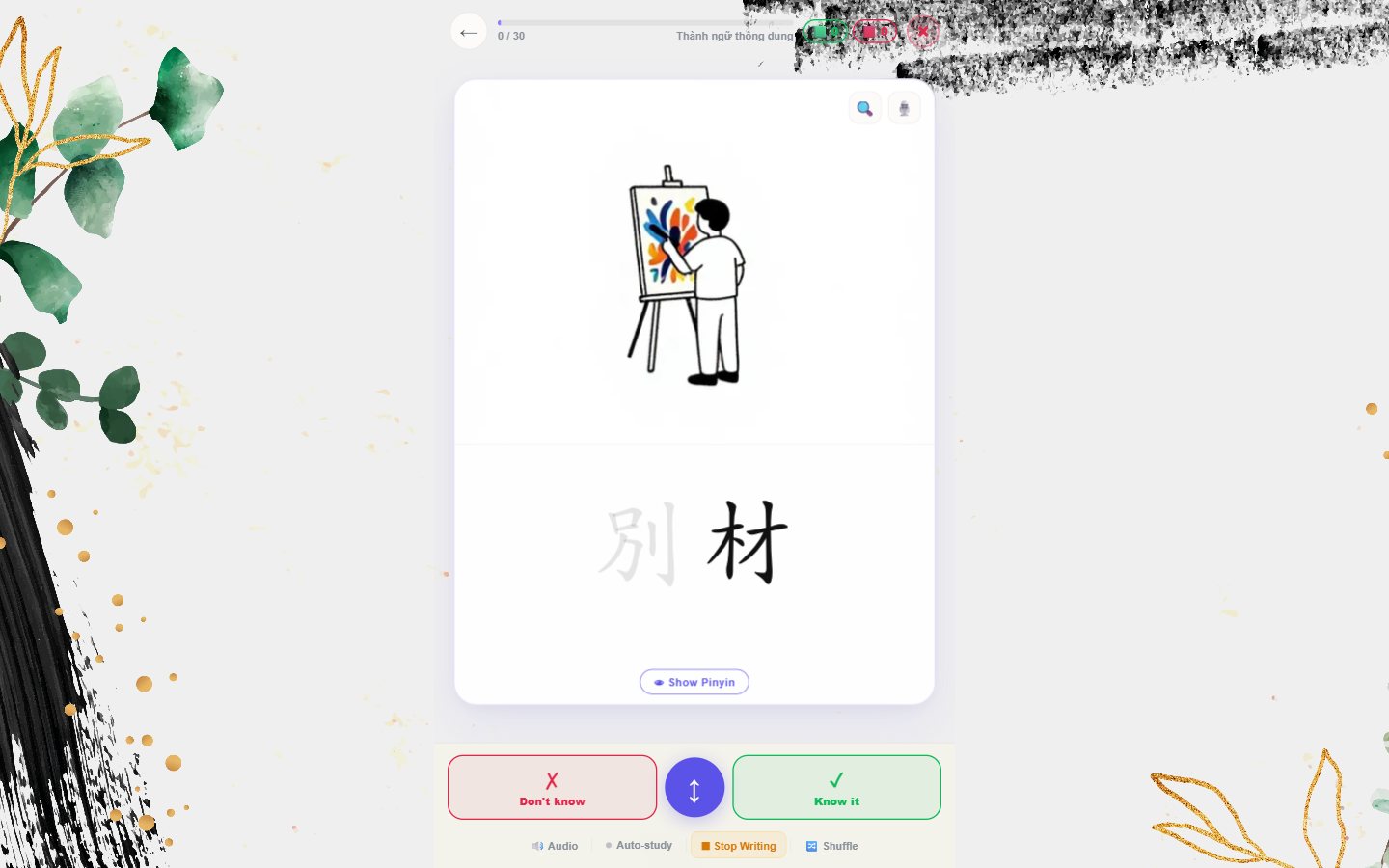
Why is tracing on a screen still "hands-on" enough? Because what the brain needs at the engraving tier is stroke sequence and shape, not the friction of paper. Tracing forces the hand along each stroke's exact trajectory — exactly what shape memory needs.
And the engraving tier never stands alone: the same card also carries the line-art image, pinyin, meaning, audio, and the mnemonic story. A new character gets engraved by several strands at once — the hand is only one of them, but it's the strand you can't skip on the first encounter.
3. The keeping tier: typing for learned characters
After the first encounter, the problem changes completely: no longer a handful of new characters, but hundreds of characters that need recall every week. At that scale, handwriting collapses under simple arithmetic: copying one word takes seconds to tens of seconds; typing one word takes a fraction of that, and the machine grades right/wrong instantly.
But speed isn't the deepest reason. The deepest reason is the quality of the recall: when you type 努力 from the cue "to try hard," you walk the entire road from meaning to written form — the exact road you'll walk when texting a colleague or emailing a partner. Handwriting walks that road too, but far too slowly to walk it the number of times required; and glancing at the answer doesn't walk it at all.
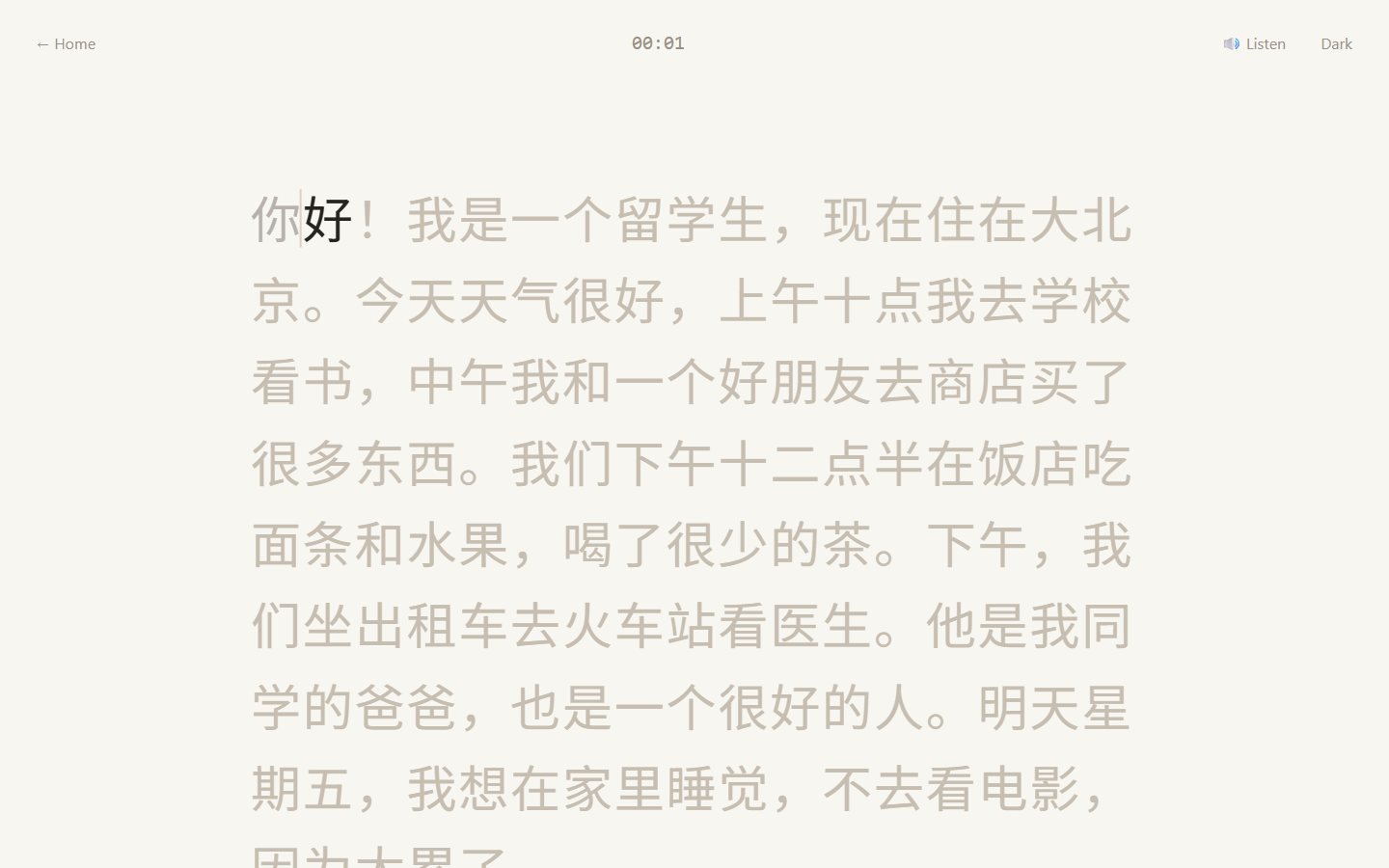
One more keeping tool for days that demand iron discipline: Deep Memory — a single item, type it back, no skipping. If typing is the river of review flowing steadily, Deep Memory is the weight room: few sets, heavy plates, no way out.
4. The savoring tier: pen and paper for characters you love
Saying typing wins the keeping tier doesn't mean pen and paper are obsolete. Some evenings aren't for efficiency: brew tea, spread out paper, and write 静 or 忍 slowly with an ink pen — feel the pause of the vertical stroke, the release of the sweep. Job C isn't measured in characters per minute; it's measured in the relationship between you and the character.
Trace strokes so the character enters your hand.
Type so the character stays.
Handwrite so the character becomes a friend.
For those who need handwriting for pragmatic reasons — pen-and-paper exams, teaching, signing your name — the engraving tier on the flashcard is exactly the stroke-order practice; and pen and paper at home is where you graduate from tracing to freehand writing. Neither tier cancels the other.
5. Assembling the three tiers into one loop
The real strength of a unified workspace is that these three tiers don't live apart. They close into one loop on the same dataset:
6. Conclusion
"Type or handwrite?" — the mature answer is: both, at the right tier, at the right moment. Trace strokes while the character is still fresh. Type while the character needs to survive months. And reach for pen and paper when the character has become part of who you are. The old debate deadlocks because it makes one tool carry all three jobs; a modern workspace has room for all three without forcing you to pick a side.
Don't choose between pen and keyboard.
Choose the right job for each —
then let memory be the referee.
Try all three tiers in one session
Open a new character card: trace the strokes. Then Deep Memory: type it back. This weekend: one page of paper for the character you loved most this week.
Sources / notes
- Longcamp, M. et al. — The influence of handwriting practice on letter recognition (motor memory & learning). https://journals.sagepub.com/doi/10.1111/1467-9280.03453
- Karpicke, J. D., & Roediger, H. L. (2008). The Critical Importance of Retrieval for Learning. https://learninglab.psych.purdue.edu/downloads/2007/2007_Karpicke_Roediger_JML.pdf
- Typing speed statistics. https://fastfingers.net/typing-speed-statistics