The question this article answersIs Matrix Hanzi Pro worth using?
Short answerMatrix Hanzi Pro is intended for learners who want to make recall the centre of study and use detailed character data rather than simply extend a word list. Learners seeking a different approach may not need it.
Every year brings dozens more apps promising to make you good at Chinese: streaks to keep you hooked, gems to reward you, leaderboards to race you against strangers. Very few of them answer the one question that actually matters after six months: how much do you still remember? Matrix Hanzi Pro was built around that question — and the six reasons below all grow from the same philosophy.
1. Because it treats memory as the main job, not a side quest
Most language tools optimize for the feeling of learning: endless new content, a fresh lesson every day. But the real enemy of the Chinese learner isn't a shortage of content — it's decay. Matrix Hanzi flips the emphasis: content is the raw material, and the main job is keeping that material alive in your head.
Concretely, the recall loop is designed as a closed circuit: mark a character you're unsure of right where you meet it; mistakes gather themselves; Home turns those two lists into your next session; six modes recall the same item from six different directions. No notebook, no third note-taking app, no homemade Excel file.
Other apps sell you the feeling of progress.
Matrix Hanzi sells you characters that are still there next month.
2. Because the data is deep, not just long
Quantity alone is impressive enough: over 16,800 vocabulary items across simplified HSK and traditional TOCFL, 3,008 idioms, more than 33,000 sentence patterns. But what sets this data apart is the depth of every single record:
 白衣蒼狗
白衣蒼狗
Every vocabulary item carries its character composition and a mnemonic story; every sentence pattern carries a component-by-component analysis and a structural template; every item has an exclusive line-art image and audio. This is not a list to scroll through — these are knowledge objects: units of knowledge complete enough to understand, remember and use.
3. Because it respects your time
For people who work or go to school, study time usually comes in 10–20 minute gaps wedged between other things. Matrix Hanzi is designed for exactly those gaps:
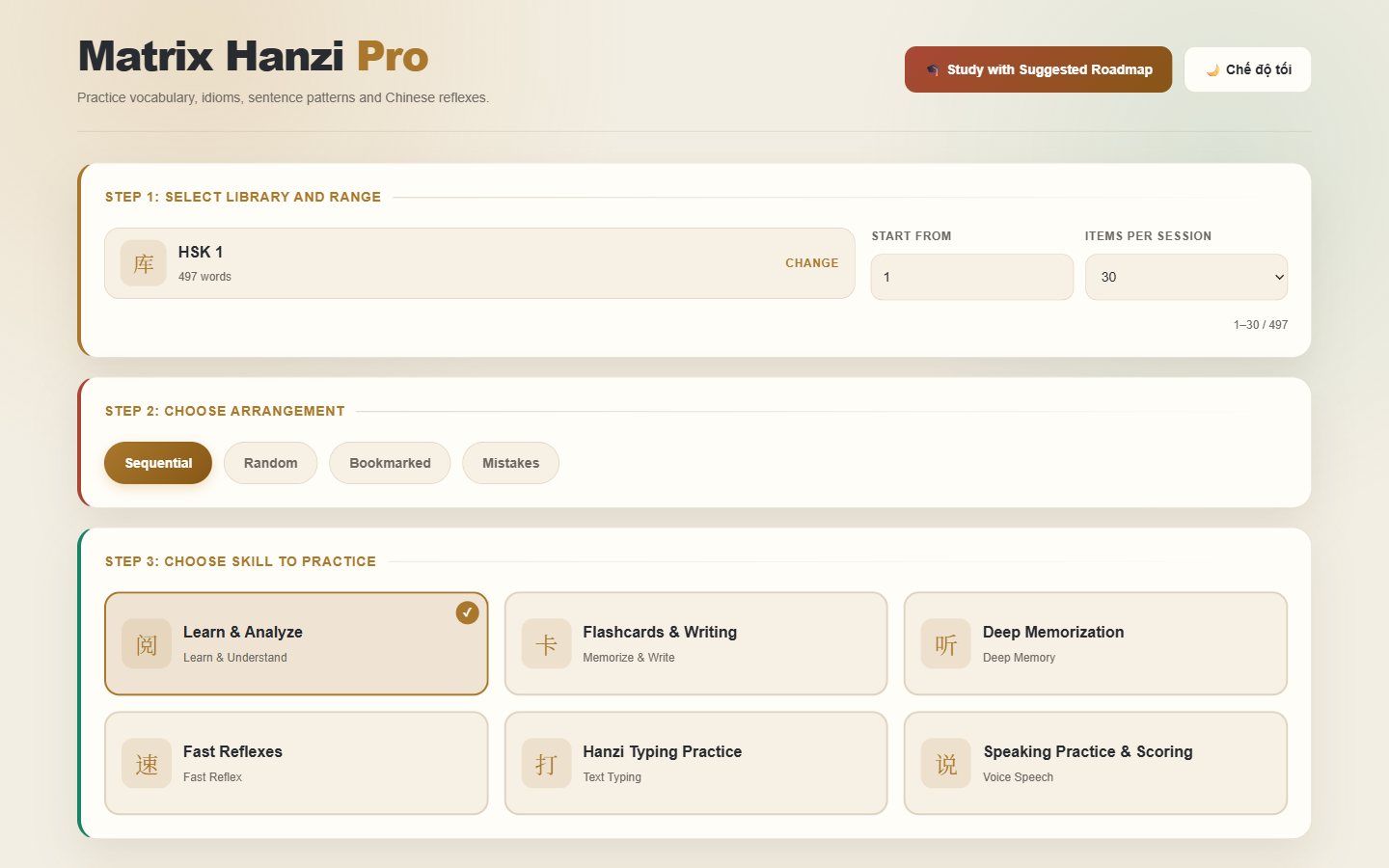
4. Because it respects your wallet and your privacy
The usual monetization matrix of language apps: lock the core content behind a paywall, demand an account, sync everything to the cloud, then resell your attention. Matrix Hanzi goes another way:
Free core
Six practice modes and the data library, open right in your browser.
No login, no cloud profile: your progress, marks and mistakes are stored on your own machine.
Optional advanced tier
Features that cost real compute — like detailed AI pronunciation analysis — are there for people who genuinely need that depth.
You upgrade for the value, not because a door slammed shut halfway through.
Privacy here isn't a slogan: when your learning data lives on your own machine, there simply isn't anywhere else for it to leak.
5. Because it grows with your energy and your level
On day one you need someone holding your hand: HSK 1, a scope of 30, cards flipped slowly. In year three you need something else entirely: traditional TOCFL, idioms, long sentence patterns, typing passages you wrote yourself, speaking and getting scored. The same product holds both of those people — and every version in between:
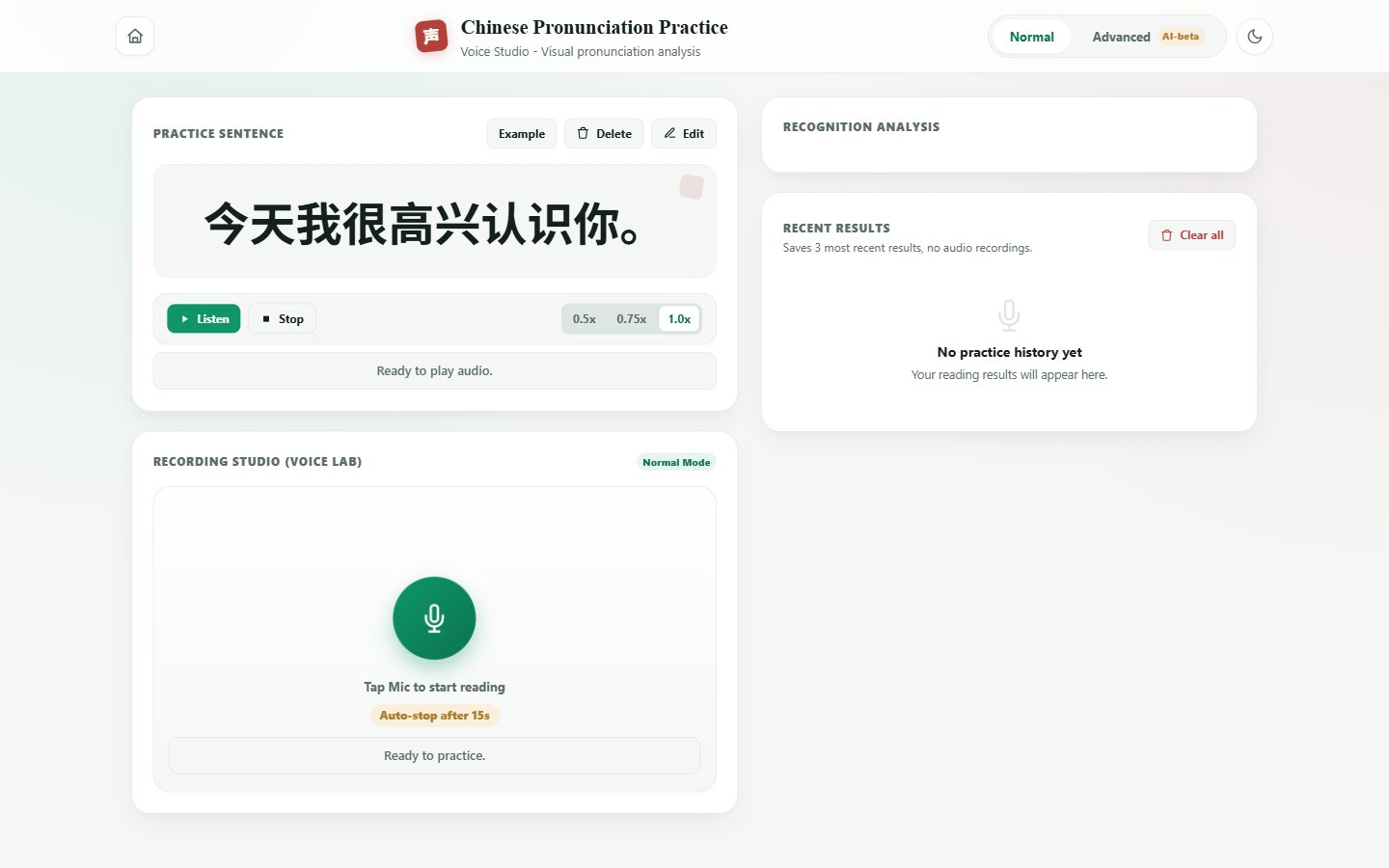
One more rail for people who don't want to find their own way: the suggested practice roadmap combines modes day by day, with progress saved locally — discipline pre-cast into a schedule.
6. Bluntly: who is this product not for?
Advice worth trusting has to come with its limits. Matrix Hanzi will disappoint you if you're looking for:
In other words: Matrix Hanzi is for people who have accepted that learning a language is their own job — and just want a decent place to do that job every day.
7. Conclusion
You should use Matrix Hanzi Pro because it's rare in three ways: it treats memory as the main job instead of a side quest; it treats data as knowledge with depth instead of a list to scroll; and it treats learners as adults — with a right to privacy, with their own time budget, with tired days and good days. Six modes, one dataset, one closed recall loop: simple enough to start tonight, deep enough to stay for years.
Don't pick an app because it keeps you busy.
Pick the place that makes you remember.
The door is open — no key needed
No login, no installation. Pick HSK 1, flip your first ten cards, and feel for yourself the difference between scrolling content and training memory.
Sources / notes
- Matrix Hanzi product profile — the six-mode architecture, Free Core and the AI tier.
- Karpicke, J. D., & Roediger, H. L. (2008). The Critical Importance of Retrieval for Learning. https://learninglab.psych.purdue.edu/downloads/2007/2007_Karpicke_Roediger_JML.pdf
- Murre, J. M. J., & Dros, J. (2015). Replication and Analysis of Ebbinghaus' Forgetting Curve. https://journals.plos.org/plosone/article?id=10.1371/journal.pone.0120644