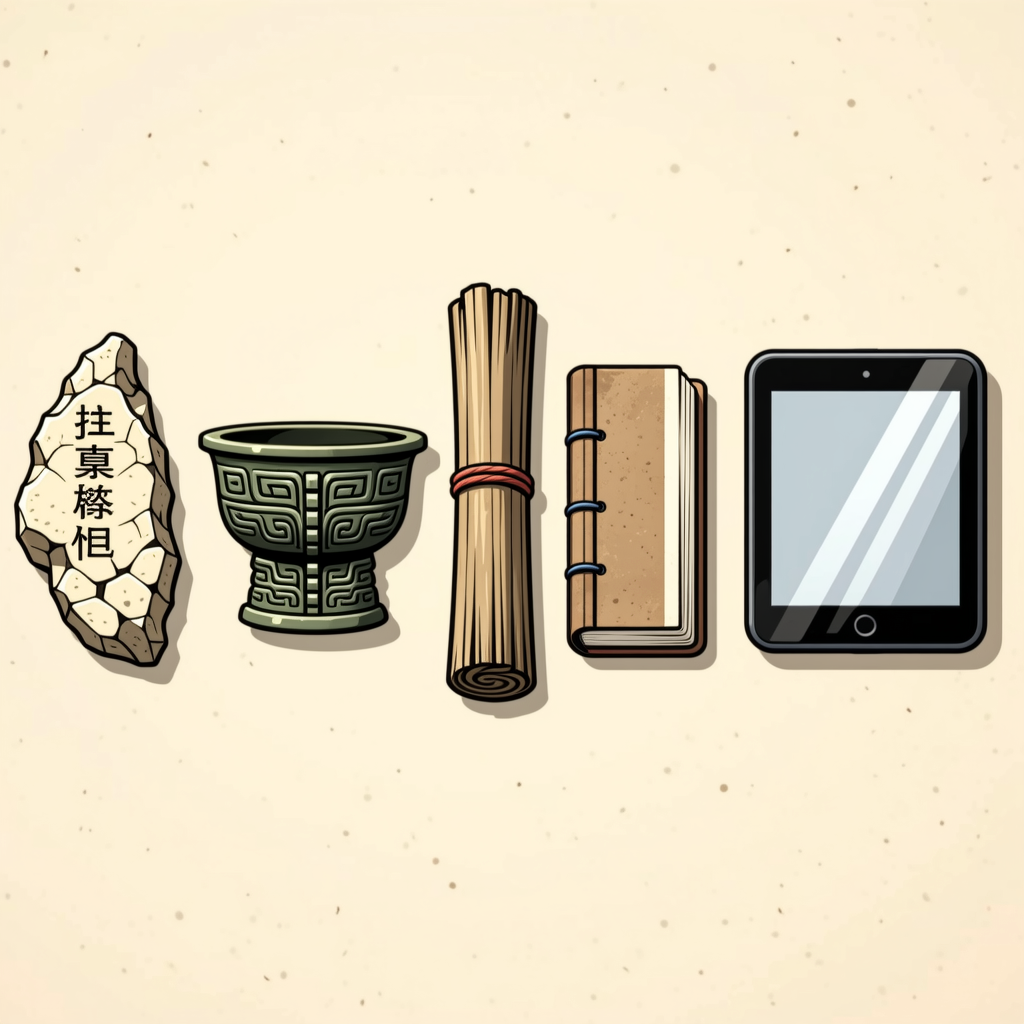
This chapter answers the questions beginners actually start asking once they can read a handful of characters: how old is this writing, who decided what a standard character looks like, why does modern written Chinese not read like ancient Chinese, and why is there a Latin-letter system called pinyin sitting on top of it.
You do not need any of this to say your first sentences, and you should not spend your first weeks on it. What it gives you is a filter. It tells you which claims about Chinese are documented, which are legend, and which were invented by whoever wrote the listicle you just read.
Every statement below carries its own confidence level, and where the record is thin or contested the text says so out loud rather than smoothing it over. Where a number appears, it appears with its year, its definition, and its source — the one habit from this chapter that will serve you in every other.
Three things that are not the same: attested writing, disputed marks, and legend
The oldest confirmed, fully functional Chinese writing is the oracle-bone corpus of Yinxu, near Anyang: inscriptions from the late Shang period.
The dating of that corpus rests on anchors this guide's evidence base could not fully verify, and there is no independent English-language corroboration of the detail either, so the claim is stated the way a specialist would state it: Chinese writing has about three thousand years of attested history.
That phrasing is deliberate. No precise BCE range is given anywhere in this book, because the primary evidence that would support one is not in the record this chapter is built on.
Around that single fact sit two categories that beginners constantly merge into it.
First, pre-writing. Incised marks from the Neolithic site of Jiahu are real artifacts.
But they are not considered writing: they show no phonetic value, no syntax, and no sequenced signs — which is exactly what a set of marks has to provide before anyone may call it a writing system.
How those marks should be dated, and how firm the "not writing" judgment is at its margins, remain open questions rather than settled headlines.
What is not in doubt is the conclusion drawn from them. Popular stories that Chinese writing is 7,000 or 8,000 years old — and the more exotic claims that it came from Egypt or arrived by way of Korea — all count the Jiahu marks as writing, and archaeology does not accept that.
If you see a date that old attached to Chinese writing, that is the tell that someone has skipped a step.
Second, legend. Cang Jie, the figure credited with inventing writing, belongs here.
He is first clearly recorded in the text known as the Huainanzi, and even that attestation is carried with uncertainty, since it was not verified against a primary source.
Scholars read him as a story about the standardization of writing — someone bringing order to what already existed — not as a report about an inventor.
The ancient year sometimes attached to him in popular listings is not part of the record and should not be repeated.
A practical rule, and the one thing from this section worth passing to a friend: keep the three labels apart.
Attested writing gets a date of about three thousand years. Disputed pre-writing gets the word "disputed". Legend gets the word "legend". Each deserves one sentence, and they never combine into one origin story with one age.
One more piece belongs here because it is the question people ask next: how much of the old script can a modern reader understand?
There is no defensible figure for that. The one survey that produced such a figure was retracted, and this book does not resurrect it.
The honest version is qualitative. Modern characters are the same continuing writing system as the ancient scripts, with shapes changed stage by stage, which is why an oracle-bone graph can legitimately be shown as the ancestor of a character you have learned.
That continuity has no percentage attached to it, and any percentage you see for it is unearned.
And the practical observation: oracle-bone script is unreadable without specialist training. Not "difficult" — unreadable, unless you have studied it.
Why modern written Chinese reads "modern": the vernacular shift
Written Chinese today is close to spoken Mandarin by design, and that design has a period.
In January 1917, Hu Shi published 文学改良刍议 ("Suggestions for Literary Reform") in the magazine 新青年 ("New Youth"), with its list of eight prohibitions for writers (八不主义), arguing that writing should use 白话 (báihuà) — the vernacular, the language people actually speak — instead of classical literary Chinese.
About a month later, Chen Duxiu followed with 文学革命论 ("On Literary Revolution") and its three principles (三大主义), which turned a style proposal into an organized literary movement.
All of those dates are carried here on tertiary sources. Treat the sequence as documented and the individual months as approximate; even the "about a month later" ordering is derived from the dates themselves rather than independently sourced.
Two further facts anchor the shift.
Lu Xun's 狂人日记 ("A Madman's Diary"), published in April 1918, is usually described as the first modern vernacular short story. Keep the hedge: the superlative is contested in scholarship.
And in January 1920, the Ministry of Education of the Beiyang government ordered that primary-textbook grades 1 and 2 switch to the vernacular.
That order was grade-limited. It is not true that "all schooling went vernacular" in 1920, and you will see that overstatement corrected in any careful history.
The interpretation all this supports is the reason the section exists in a beginner's book. Because the vernacular side won, today's written Chinese is the baihua norm of the 1917–1920s, deliberately close to spoken Mandarin.
That is why a modern Chinese article reads modern rather than archaic, and why a Chinese learner can, in principle, read a newspaper and recognize much of what they have been taught to say.
Written Chinese is still not identical to speech, though. The new written language kept absorbing vocabulary and sentence patterns from 文言 (wényan), the classical register — a point this guide marks uncertain, but one you will confirm yourself the first time a textbook sentence sounds nothing like anything anyone says out loud.
How the standard spoken language became the default
普通话 (pǔtōnghuà, "Putonghua", literally "common speech") is defined by three criteria: the Beijing phonological system as the pronunciation norm, the Northern dialects as the base dialect, and exemplary modern vernacular writings as the grammatical norm.
That definition is not a slogan from a conference. It is the binding text of Article 2 of the 《国家通用语言文字法》 — the Law on the Standard Spoken and Written Chinese Language — adopted on 31 October 2000 and effective 1 January 2001.
The conferences of 1955 and 1956, which first worked out these arrangements, belong in the story as its origin and only as its origin. They are not the legal source, and the three criteria are not attributed to them.
Putonghua is the standardized form of Northern Mandarin. It is not a separate language that was invented and installed over the others.
Two earlier names for roughly the same project — 官话 (guānhuà, "official speech") and 国语 (guówǔ, "national language") — refer to the same long effort at standardization. No fine dates are given for them here, because the record does not support any.
How did a spoken standard become the default? Not by declaration alone.
From the 1950s the state ran active promotion: teacher training, broadcaster training, school curriculum, and requirements on media use. The legal status of Putonghua is the endpoint of that machinery, not the cause of it.
That distinction is the answer to a question beginners ask in a different form: "is Putonghua natural, or was it imposed?" Neither. It grew out of the speech of one broad dialect region, and then a state chose to teach, broadcast, and certify one standardized form of it.
This is a general fact about national standard languages rather than a special feature of Chinese — this book's reading, offered as interpretation — and noticing it is the beginning of reading the language's history without either idealizing or demonizing it.
The instruments of the promotion in this record are named only at the level of the programme: teacher and broadcaster training, the school curriculum, and requirements on media use. Details of certification schemes and promotional campaigns stay marked uncertain here, so this book gives the mechanism and not the machinery's paperwork.
One gloss is unavoidable, and it carries a political weight beginners should understand from the start. The official term used in PRC policy for local varieties is "dialect" (方言, fāngyán).
Linguists, when they describe Cantonese and the other major southern varieties, generally treat them as separate Sinitic languages — not mutually intelligible with Putonghua — even though official usage calls them dialects.
That the official word is a policy convention rather than a linguistic finding is one reading of this gap, and this book marks it as interpretation, not fact.
How the Sinitic family is subdivided, how many groups a given scheme names, and how classification interacts with intelligibility remain open questions in this record. No intelligibility percentage and no count of "dialect groups" is printed here as sourced fact.
Because legal-status statements are exactly the kind of claim that quietly goes out of date, each one carries an as-of date.
As of 2026-09-06, the full text of the 2000 law itself was not directly located for verification in this guide's evidence base. A revision, however, was officially announced on the State Council's English-language government portal, dated 2025-12-27, effective 2026-01-01: the announcement describes extending standard-language requirements into public and digital domains, including clauses touching online games and an annual publicity week in the third week of September. The revised full text was not located, so article-level details remain at announcement level.
The announcement itself is confirmed on the official portal; what remains unconfirmed is the revised statute text, which was not retrieved. Article-level details are therefore known only as the announcement summarized them, and the exact mapping of reported clauses to the final legal text remains inferential.
Any statement in this book about what Chinese law requires is therefore a statement of the form "as of 2026-09-06, as reported".
How far Putonghua has actually spread
Chinese sources measure this with 普及率, the "rate of penetration": the share of the population of the PRC able to communicate in Putonghua, measured by national survey.
Read the series with the years and the definitions attached, which is the only way the numbers mean anything:
- 53.06% — the year-2000 baseline national survey figure; the starting point of the series.
- 80.72% — the 2020 national survey figure, reported at a Ministry of Education press conference on 2 June 2021, and described there as meaning the 13th Five-Year target had been met. This figure was checked directly against official reporting and cross-checked against the government's own English-language publication (MOE, 2021).
- 85% — a planned target for 2025, that is, a goal set in a plan document, not a measurement of anything.
The series is the point. A single unlabeled percentage describing Putonghua's reach is a number without a meaning, and the first question to ask of it is which year and which definition it carries.
A further variant figure attributed to 2023 circulates in some write-ups. It has no source in this record and is excluded here, which is why no 2023 number appears above.
Simplification: when, why, who decided, and what it cost
The mainland's simplified characters come from a dated administrative sequence, not from a single decree.
A draft scheme was issued by the language-reform committee in January 1955 and discussed publicly before promulgation. The resulting 《汉字简化方案》 ("Scheme for the Simplification of Chinese Characters") was approved by the State Council in January 1956 and introduced in batches; it became the mainland standard.
In 1964 the 《简化字总表》 ("Complete List of Simplified Characters") consolidated the scheme into about 2,200 simplified characters. The exact totals circulating in tertiary sources are not verifiable here, and so the rounded figure with its "about" attached is what this book prints. Whether that 1964 list was published before formal approval, and precisely when, is a matter this record marks uncertain.
The State Council reissued the list in 1986 with minor revisions, and that reissue became the long-stable norm.
There was one further round, and it was undone. A second-round scheme, 二简字, appeared in 1977 and was formally rescinded by the State Council in 1986.
Its spellings are non-standard today, and none of them is a correct modern form for the word it was meant to write.
A count of the characters in that rescinded scheme is sometimes quoted; it is not printed here, because the source behind it exists only as a title.
Since 2013 the controlling standard has been 《通用规范汉字表》 ("Table of the General Standardized Chinese Characters"): 8,105 characters in three levels of 3,500, 3,000, and 1,605 (PRC official enumeration, mainland scope), published under State Council authority with the Ministry of Education and the National Language Commission compiling and implementing it.
Two cautions that stop common errors. The 8,105 figure is the size of this modern standard table; it is not an answer to "how many Chinese characters are there", a question with no defensible single answer.
And the 3,500 figure is the table's first level only — never the size of the simplified inventory.
The level breakdown is given with its own limit: it should be re-verified against the State Council document behind the table, and the day-level publication date is not asserted.
"Who decided" has an institutional answer and deliberately no biographical one: the State Council issues, and the Ministry of Education together with the National Language Commission compile and maintain.
No individual deserves the credit or the blame, and no names are given here, because the record does not support naming them.
Simplified characters are the legally official script, and at the same time traditional and variant forms remain lawful in defined settings such as calligraphy, art, and historical documents.
That exception is an official-rule claim carried with uncertainty: the article number behind it could not be verified until the primary law text is retrieved.
Whether simplification was a gain or a loss is presented here as an unresolved disagreement, because the sources hold both positions and neither is settled.
The documented official aim was literacy. Simplification was one of three tasks of the state language programme — alongside promoting Putonghua and romanization — explicitly aimed at basic education and popular literacy.
Against that, the documented costs are real: merged variants create ambiguity when reading pre-1956 texts, and simplification reduced direct access to older printing.
The figures often quoted for the achievement side of the campaigns — cumulative counts of people made newly literate — are official claims this book could not verify, and they are not printed here. The quantified versions of the cost side that circulate — percentages and money figures — are excluded from this book entirely.
What genuinely remains open is the earlier history: the 1930s phase of the reform movement and the 1935 list of first-batch simplified characters are an open question here, not a chapter.
Romanization, and the pinyin-only episode that never happened
《汉语拼音方案》 ("Scheme for the Chinese Phonetic Alphabet", pīnyīn) was approved and promulgated on 11 February 1958 by the First National People's Congress.
Note the voice: that date rests entirely on tertiary carriers and stays marked uncertain until the primary decision text is retrieved. It is repeated because it is the best-supported statement available, not because it is verified.
Romanization is older and stranger than pinyin. It has a missionary origin: Jesuits in the early seventeenth century, including Matteo Ricci and Nicolas Trigault, transcribed Chinese with Latin letters. This is background, not a dated fact — none of the claims in this paragraph carry the authority their enthusiastic retellers give them.
Later, in the late imperial and Republican periods, mass-mobilization romanization movements appeared, including Latinxua Sin Wenz.
Correct one gloss you will meet: Sin Wenz was a Latin-alphabet romanization of Chinese, not a character simplification. The two reforms are different projects with different mechanisms, and their origin dates and methods stay uncertain in this record.
None of these movements displaced characters.
Pinyin's role is fixed by law: the 2000 standard-language law makes it the state's phonetic-annotation and romanization norm for names, place names, and documents, designed as a tool for learning characters and spreading Putonghua — not as a replacement script.
The statute text is not in the record, so this is an attributed official rule rather than a quoted one.
The one claim in this section that stands on firm ground is the international one: pinyin is the basis of ISO 7098, the international standard for romanizing Chinese, first issued in 1982.
Nothing further about editions is asserted as settled. Where a current edition must be named, only 2015 is defensible, and even that is flagged as pending confirmation against the catalogue's current record; a "1991" version label should not be presented as current.
And the story you may already have read — that Chinese once planned to abandon characters and write entirely in pinyin?
The documented part is the outcome: the proposal to write Chinese wholly in pinyin lapsed, because pinyin and characters turned out to be complements rather than competitors. Pinyin carries pronunciation, input, and annotation; characters carry the text.
Who exactly proposed full replacement, when, and what ended it remain an open question, and this book leaves them one rather than filling them in.
Characters outside China: what a beginner will actually see
Japan, Korea, and Vietnam all belonged to the Chinese-character sphere: each wrote Classical Chinese for official and literary purposes, and each later adapted the character script — or took up a Latin script — to write its own language.
This is a wide generalization over a large literature and is carried with the uncertainty that a wide generalization deserves.
In Japan, kanji are not a relic. They are a working part of everyday writing alongside the two kana syllabaries.
Characters make up something like half of what you see on a Japanese page — and note what that sentence is and is not. It is a qualitative impression of what a page looks like, not a measured statistic; it has no date and no stated method, and no survey of Japanese print lies behind it.
In South Korea, hanja — Chinese characters used in Korean — have contracted sharply. As of 2026-09-06 they survive mainly in formal contexts: legal and academic writing, where they disambiguate homophones.
The wording that is licensed here is "still visible in formal Korean writing" — not a claim about Korean law or policy, and not a dated statement about usage, since neither the Japanese character-list revision dates nor any Korean policy date are in this record.
Korea's share of vocabulary of Chinese origin is often put at around 60%, and most of it is now written only in hangul.
Treat that as an order-of-magnitude estimate. Its value depends heavily on what is being counted — dictionary headwords rather than the words that actually occur in running text — and the method behind it is not documented in this record.
For a Chinese beginner, all of this is recognition-level knowledge.
A practical rule: expect characters everywhere in Japanese text and occasionally in Korean text, and treat that as useful familiarity rather than a second writing system you are obliged to acquire alongside Chinese.
Printing, encoding, and the box that is not the character's fault
This section is capped at recognition depth on purpose: nothing in the available record reaches a standards body, so no repertoire counts, no code-point ranges, and no committee resolutions appear here.
What a beginner genuinely needs is one definition and one causal direction.
Definition, offered as a definition and not as evidence: "tofu" is the practitioner's nickname for the empty box or fallback shape a reader sees when their software has no usable glyph for a code point that is present in the text. It is a label for a display outcome, not a standards term.
Interpretation, offered as interpretation: the direction matters. The character is in the text; the missing piece is on the reader's side — in the font, the system, or the app.
A box is therefore never evidence that a character is fake, non-standard, or discontinued. If your device renders a name or an old variant as boxes, the fix is on your side of the screen.
One further sentence, also at recognition level: where a shared encoded character is drawn slightly differently in Chinese, Japanese, and Korean print, that is glyph shape and font or locale selection sitting on top of a common encoding. It is something you will notice, not a rule you must obey, and no technical requirement is asserted about it.
The durable encoding idea, stated qualitatively: characters live in one main block plus a series of extension blocks that grow with each Unicode version, and the international standard character set tracks Unicode edition by edition rather than instant by instant.
What that sentence buys you is a way to understand why the same text can render on one device and not on another: the encoding is shared and versioned, while the fonts that realize it are installed locally and updated on their own schedule.
No repertoire total is given for either of those things in this book, in either direction. The counting questions — how many code points, how many characters per block — have no answer this record can stand behind, and a number invented for them would look exactly like a real one.
On China specifically: there is a mandatory national character-encoding standard, GB 18030, which determines which characters system software in the PRC must handle. That is the entire claim, and no coverage figure, extension list, or Unicode-version statement is attached to it.
Everything in this section is hedged because the encoding claims in the record have no standards-body or government source behind them. The printing-history half of this topic — how movable type and block cutting shaped character forms — is unsourced in this record and is simply not told here.